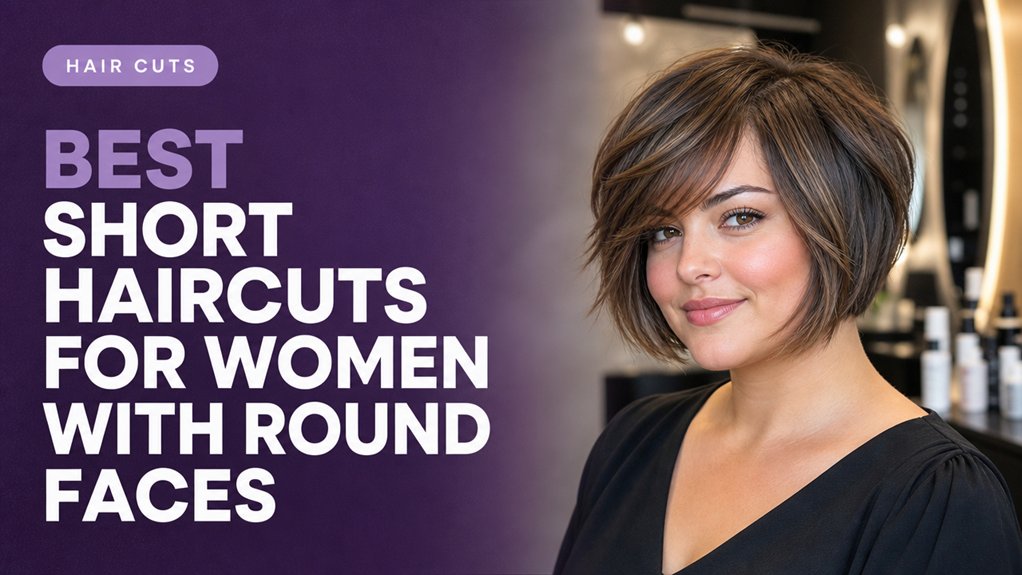
Best Short Haircuts for Women With Round Faces
Pixie cuts, A-line bobs, and layered short styles work best for women with round faces because they direct the eye vertically rather than horizontally. Tapered sides, crown volume, and side-swept or curtain bangs all help elongate the face’s appearance. Styles that sit below the chin add perceived length, while cheek-level bulk and blunt straight-across bangs reinforce unwanted width. The right cut, styling technique, and product combination make all the difference—and there’s much more to explore ahead.
Key Takeaways
- Pixie cuts with volume on top and side-swept fringe elongate round faces by emphasizing vertical height over horizontal width.
- A-line and longer bobs falling below the chin visually stretch the face and create a slimming effect.
- Curtain bangs and side-swept bangs add diagonal lines that elongate the face, unlike heavy blunt bangs.
- A deep side part introduces asymmetry, slimming facial width and preventing a rounded, symmetrical appearance.
- Avoid chin-level blunt cuts and cheek-level volume, as both emphasize width and reinforce natural roundness.
Short Haircuts That Actually Flatter Round Faces
Choosing a short haircut for a round face comes down to one core principle: vertical emphasis over horizontal width. Cuts that lift the crown, tighten the sides, and extend past the jawline consistently produce the most flattering results.
Angled bobs with a shorter back and longer front create a diagonal line that adds definition while drawing the eye downward. Layered cuts with volume concentrated at the crown shift attention upward, making the face appear longer.
Diagonal lines elongate. Volume at the crown lifts. Both work together to make a round face appear longer.
Face-framing layers starting just below the chin elongate proportions without removing length. Textured shags and butterfly-inspired cuts reinforce the same formula: movement at the top, reduced bulk at the sides.
Avoiding heavy width near the cheeks is a consistent requirement across every silhouette that works well for round faces. A textured pixie cut achieves this balance by combining piecey layers on top with tighter sides and back, enhancing facial features without adding unwanted width. Working with an expert master stylist ensures the cut is personalized to your specific face shape and hair type for the most flattering outcome.
The Best Pixie Cuts for Round Faces
Pixie cuts can work exceptionally well on round faces when the structure prioritizes vertical emphasis over horizontal spread. Crown volume, longer top layers, and tighter sides create the elongated silhouette that most flatters this face shape.
Three cut types consistently deliver the best results:
- Tapered pixie — short, tapered layers slim the sides and add structural definition.
- Pixie with volume on top — longer top layers allow height-directed styling that visually lengthens the face.
- Soft-waved pixie — gentle texture maintains balance without adding bulk at the cheeks.
Controlled nape length and soft face-framing pieces reinforce proportion. Keeping the neck exposed lightens the overall look and contributes to a more balanced silhouette. The goal remains consistent: simulate an oval shape by keeping width minimal and directing visual weight upward. A side-swept fringe can further soften facial angles while contributing to a more elongated appearance. Working with expert stylists who take the time to understand your face shape and hair type ensures the cut is tailored specifically to your features rather than applied as a one-size-fits-all approach.
Bob Haircuts That Slim a Round Face

Bob haircuts offer round-faced women several structural advantages, particularly when length extends past the chin to create a vertical line that counters facial width.
The A-line bob stands out as a top choice, as its angled silhouette draws attention downward and produces a natural slimming effect. A side part can further enhance this effect by breaking facial symmetry and drawing the eye diagonally to create the illusion of length.
Choppy layers add further dimension by introducing angular pieces that break up circular facial curves and prevent a flat, wide appearance at the sides. The inverted bob also works well for round faces, as it tapers from back to front to add volume where it flatters most.
Consulting with an expert stylist ensures the bob is tailored to your specific hair type and texture, helping the cut maintain its shape and slimming effect between appointments.
Longer Bobs Create Length
When it comes to slimming a round face, longer bobs outperform their shorter counterparts by drawing the eye downward rather than outward. Length below the chin prevents hair from ending at the face’s widest point, reducing horizontal emphasis.
Three design principles make longer bobs effective:
- Below-chin length visually stretches the face by directing attention downward toward the collarbone.
- Center parts establish a vertical line through the face, reinforcing symmetry and creating a slimmer silhouette.
- Soft layers reduce side bulk, removing weight from the cheekbone area without sacrificing structure.
Collarbone-grazing cuts deliver the strongest elongating effect. A straight, polished finish reinforces that lengthening quality while keeping the overall silhouette controlled.
The core design goal remains elongation, never width. A dramatic angled bob simultaneously slims and shapes the face while enhancing its best features. For curly hair, beveling at the nape helps manage volume and prevent the silhouette from expanding outward at the bottom.
A-Line Bob Benefits
The A-line bob‘s defining feature—a shorter back that graduates into longer front sections—creates a diagonal perimeter that slims a round face by directing the eye downward rather than outward.
The continuous angled line reduces facial roundness more effectively than a one-length bob’s uniform silhouette. Front sections ending at or just below the chin keep the cut from terminating at the face’s widest point, while a forward sweep at the jaw shifts attention toward vertical length.
Styling enhances the cut’s structural advantages: a deep side part introduces asymmetry that breaks up roundness, and sleek sides prevent expansion at the cheeks.
A crown with light volume adds height, further elongating the face through balanced proportion rather than width. Shorter back lengths also maintain a cleaner profile view, preventing the silhouette from appearing dragged down at the sides.
Unlike the graduated bob, the A-line bob avoids heavy layering in the back, relying instead on a clean, sharp line to maintain its slimming diagonal structure without adding unwanted bulk around the face.
Choppy Layers Add Angles
Choppy layers transform a standard bob into an angular, face-slimming cut by introducing textured, piece-y ends that break the rounded silhouette typical of fuller faces.
Unlike blunt cuts, choppy layering builds vertical structure while reducing side bulk—two critical factors for round face shapes.
Three technical reasons choppy layers work:
- Angled ends redirect visual attention away from cheek fullness
- Layered structure at the crown creates vertical height, counterbalancing width
- Piece-y texture disrupts uniform roundness, producing a more elongated silhouette
Length should sit at or below the chin to extend the jaw line effectively.
Styling with sea salt spray or a rough blow dry preserves the cut’s angular definition without reintroducing unwanted side volume. The choppy bob is also low-maintenance compared to other styles, making it a practical choice for women who want a face-flattering cut without demanding upkeep.
For round faces, the classic bob is best styled below the chin with added volume to create the elongating contrast the face shape requires.
Layered Short Haircuts That Add Angles and Length
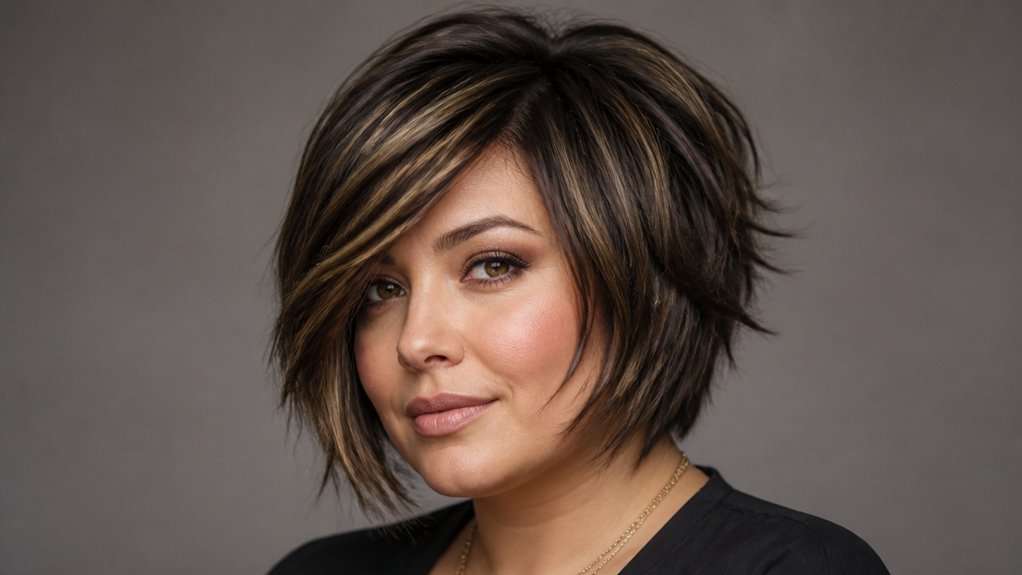
Layered short haircuts solve a specific styling challenge: adding visual angles and length to softer, rounder face shapes. Strategic layering achieves this by directing the eye vertically rather than horizontally.
Face-framing layers that begin below the chin avoid adding width at the cheekbones, while layers starting beneath the cheek area create downward movement that visually lengthens the face. Asymmetrical styling reinforces this effect — a side part breaks facial symmetry and introduces diagonal lines that counteract roundness. Expert stylists can assess your face shape and hair type to determine which layering approach will deliver the most flattering result.
Angled bobs with a shorter back and longer front further support vertical movement. Avoiding blunt, uniform cuts prevents unintended width.
When layers combine controlled structure with soft tapering near the jawline, they produce a defined silhouette that balances the face’s natural fullness without sacrificing style. A choppy bob with curtain bangs uses shadow roots and dark roots to further elongate the face while maintaining a modern, easy-to-maintain finish. For those with finer hair, maintaining a more blunt back while incorporating face framing layers helps preserve density and fullness at the front for a better overall appearance.
Curly and Wavy Short Styles for Round Faces
Curly and wavy short styles follow the same face-shape logic as their straight counterparts — volume placement, part position, and outline shape matter more than length alone.
For round faces, the priority is reducing perceived width at the cheeks while adding vertical interest.
Three cuts consistently perform well:
- Curly bob — works best with a side or off-center part to interrupt facial symmetry.
- Wavy bob — adds softness without creating a blunt horizontal line across the face.
- Curly shag or wolf-cut variation — uses texture and separation to break up width and add movement.
Point cutting and controlled layering keep curls from stacking heavily at the sides. Dry cutting techniques allow for more precise shaping of the curl pattern, resulting in a more accurate and balanced final shape.
Face-framing placement and textured ends complete the balance between shape control and natural curl definition. Voluminous curls at the crown with height at the top draw the eye upward and visually elongate a round face shape. Working with an expert hair stylist who understands your specific curl pattern and hair type ensures the final cut is tailored to your individual needs and desired results.
Which Bangs Work Best for a Round Face Shape?
Bangs can either work against a round face or actively reshape its proportions — the difference comes down to line direction and density.
Curtain bangs introduce vertical lines through a center part, elongating the face while softening cheek width.
Side-swept bangs create diagonal movement that breaks circular symmetry and draws attention toward the eyes and cheekbones.
Wispy bangs keep the forehead partially visible, avoiding the shortening effect that heavier fringe produces.
Choppy or textured bangs disrupt the face’s continuous curve through irregular ends, adding structure without a dense horizontal block.
The consistent principle across all flattering options is avoiding solid, straight-across fringe. Curly hair benefits from longer bang lengths, as shrinkage can cause shorter cuts to sit higher than intended and add unwanted width.
Heavy blunt bangs create a hard horizontal line that emphasizes width, reduces perceived length, and works directly against a round face’s best proportions. Facial proportions such as forehead height and cheekbone prominence ultimately determine how dramatically any bang style reshapes the overall appearance of the face.
Side-Swept Bangs vs. Asymmetrical Bangs : Which Wins?
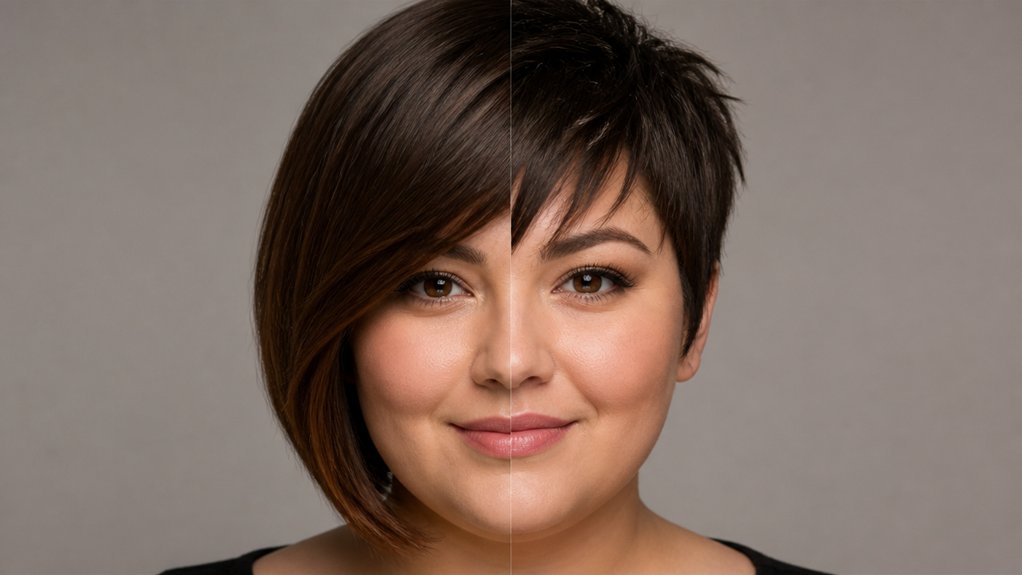
Side-swept bangs already ranked as a strong contender for round faces, but stacking them against asymmetrical bangs sharpens the comparison. Each style produces a distinct visual result:
- Side-swept bangs create consistent diagonal lines that lengthen the face and reduce perceived width.
- Asymmetrical bangs introduce uneven framing that adds edge and movement but prioritizes style impact over face-balancing.
- The goal determines the winner — side-swept bangs deliver reliable flattery, while asymmetrical bangs serve bold, editorial looks.
For round faces needing structural correction, side-swept bangs win on function. They blend naturally with bobs and pixies while narrowing the face through soft angles.
Asymmetrical bangs suit women chasing contrast and fashion-forward results, not universal balance. Side-swept bangs remain the stronger everyday recommendation. Women with cowlicks or waves also find side-swept bangs more cooperative than blunt or asymmetrical alternatives.
Curtain bangs offer another reliable option worth considering alongside these two styles, as their long layers divert attention from facial roundness while adding softness to the overall look. Scheduling regular trims every 4-6 weeks ensures curtain bangs and side-swept styles maintain their face-framing shape over time.
Short Haircut Mistakes That Make Round Faces Look Wider
Five common haircut mistakes consistently make round faces look wider, and avoiding them matters as much as choosing the right cut.
Chin-level blunt bobs create a horizontal edge that reinforces facial width rather than offsetting it. Uniform short layers add bulk at the sides, producing side-to-side volume that broadens the face instead of building vertical structure.
Excessive cheek-level volume mirrors the face’s natural roundness, making it appear fuller and shorter simultaneously. Heavy, straight-across bangs cut a strong horizontal line across the forehead, compressing the face vertically and reducing visible length.
Finally, flat styles without crown height fail to introduce the lift that elongates a round face. A middle part removes volume on top, leaving the face without the vertical emphasis needed to counteract its natural roundness. Each mistake shares one problem: it widens the silhouette instead of creating the vertical contrast round faces need.
How to Style Short Hair to Elongate a Round Face
Styling short hair to elongate a round face comes down to one core principle: build vertical lines, not horizontal ones. Every styling decision should direct the eye upward or downward, never outward.
Three techniques deliver consistent results:
- Lift at the crown — Tease roots or blow-dry upward to create height that visually lengthens the face without widening the sides.
- Deep side part — An off-center part introduces asymmetry, interrupting the circular outline and creating a diagonal line that slims facial width.
- Loose waves swept away from the face — Movement directed forward and downward streamlines the silhouette, keeping volume controlled rather than expanding outward at the cheekbones.
Avoiding side volume remains the non-negotiable rule throughout every step. A professional stylist can further refine these techniques by recommending a custom haircut tailored to your specific face shape and hair type.
Best Styling Products for Short Hair on Round Faces
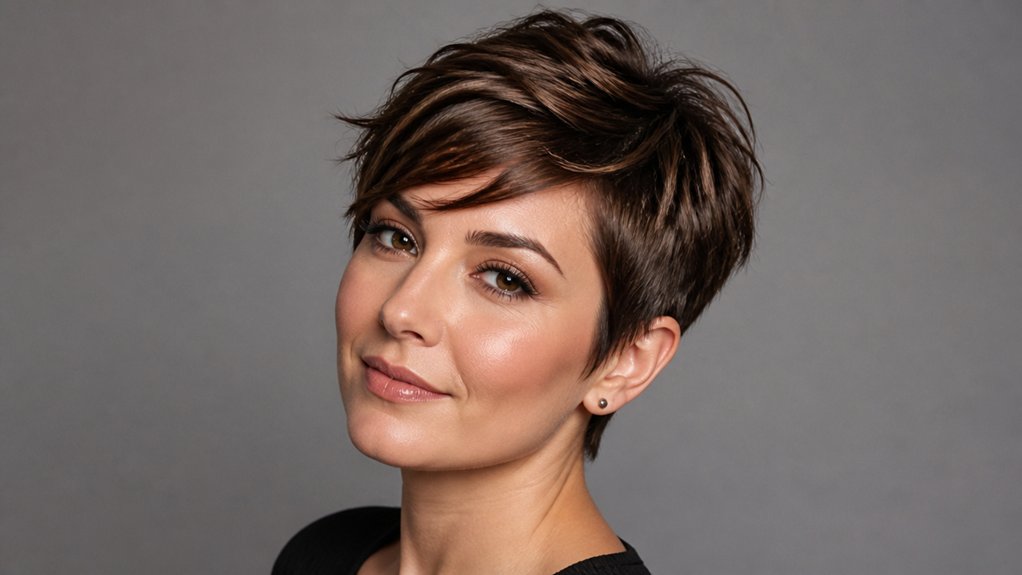
The right product selection makes a measurable difference in how short hair performs on a round face.
Volume-boosting picks—such as L’Oréal Paris Advanced Hairstyle BOOST IT Volume Inject Mousse and K18 Biomimetic Hairscience Astrolift Reparative Volume Spray—direct lift to the crown, where it elongates rather than widens.
Texture and hold essentials, including salt sprays, pomades, and firm-finish hairsprays, then lock in separation, movement, and shape without adding unwanted side bulk.
Volume-Boosting Product Picks
Choosing the right styling products makes a measurable difference for short hair on round faces, where the goal is always to build height at the crown rather than width at the sides.
Three product types consistently deliver results:
- Volumizing mousse applied to damp hair before blow-drying lifts roots and adds body without weighing strands down.
- Root-lifting spray or tonic targets the scalp directly, creating structural lift that makes the crown appear higher and the face longer.
- Texture spray adds grip, separation, and memory through the roots and mid-lengths, preventing flatness without buildup.
Lightweight formulas matter. Heavier products collapse short styles and push volume outward, widening the face’s appearance.
Heat protectant should accompany any blow-dry routine used to build shape.
Texture and Hold Essentials
Product selection for short hair on round faces comes down to matching hold level and texture output to both the cut and the styling goal.
| Product Type | Hold Level | Best For |
|---|---|---|
| Volume spray | Light | Crown lift on pixies and bobs |
| Texturizing spray | Light–Medium | Definition in choppy layers |
| Styling cream | Medium | Soft waves and face-framing curls |
| Flexible hold spray | Medium | Wavy cuts needing movement |
| Hairspray | Medium–Firm | Finishing curled or asymmetrical styles |
Stiff formulas reduce natural movement, which undermines the shape flattering round faces. Flexible hold keeps layers separated, maintains wave patterns, and preserves crown volume without collapsing texture. Placement also matters—products should support lift at the top and control fullness at cheek level.
The Right Short Haircut for Your Hair Type and Routine
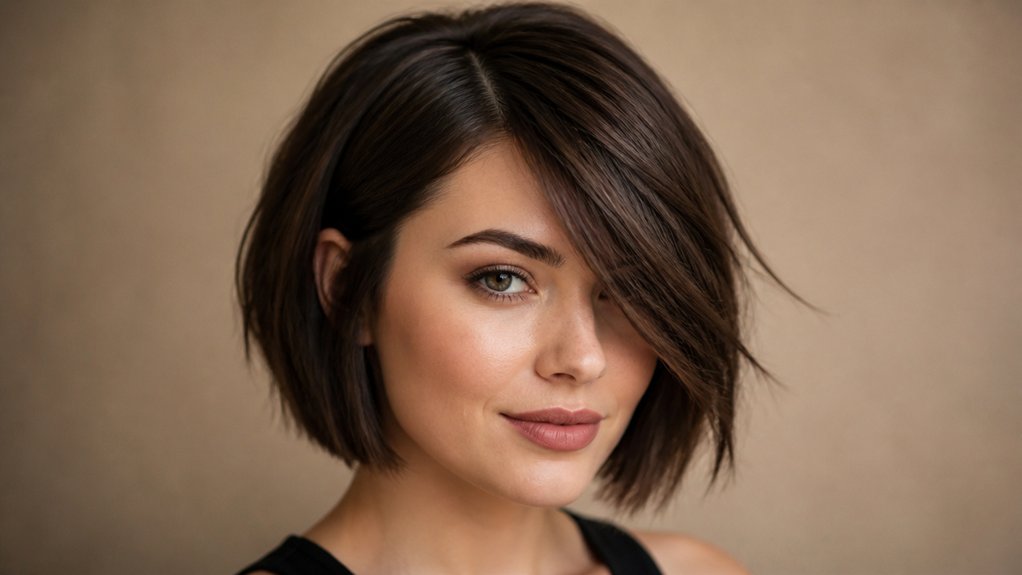
Finding the right short haircut means matching the cut to both hair type and daily routine. Hair texture and styling habits directly affect how well a cut performs long-term.
Three pairings that work well for round faces:
- Wavy hair suits layered lobs that air-dry cleanly and add movement without expanding at cheek level.
- Curly hair benefits from shapes that preserve bounce while controlling width, such as windswept short bobs with defined layers.
- Straight hair responds well to sculpted bobs and asymmetrical cuts, though these require consistent styling to maintain their shape.
Women with low-maintenance routines should prioritize cuts that perform well without heat tools.
Those comfortable with regular styling can explore sharper, more structured silhouettes that deliver stronger visual elongation.
What to Tell Your Stylist Before Your Next Appointment
A productive stylist consultation begins before the client sits in the chair, requiring her to identify her face shape, articulate what she wants the cut to achieve structurally, and bring reference photos that illustrate the desired outcome from multiple angles.
She should request specific techniques—such as face-framing layers placed below the chin to elongate a round face or disconnected sections to create vertical movement—rather than relying on vague descriptors.
Precise communication about texture, density, and past cut failures gives the stylist the technical information needed to execute a shape that performs correctly, not just one that looks right on a reference image.
Describe Your Face Shape
Before booking a short haircut, a woman with a round face shape should know exactly how to describe her facial structure to her stylist.
Accurate communication guarantees the stylist selects a shape that adds length and definition rather than width.
She should cover three key points:
- Width and length proportions: Confirm that face width and length appear nearly equal, creating a circular rather than elongated silhouette.
- Cheek prominence: Identify the cheeks as the widest point, fuller than both the forehead and jaw.
- Jawline softness: Describe the jaw as curved, not angular or sharp.
Using precise terms like *round*, *soft*, and *full through the cheeks* gives the stylist the clearest possible starting point.
Request Specific Techniques
Knowing exactly what to request makes all the difference between a short cut that works against a round face and one that enhances it.
Women should ask for length below the chin or at the collarbone, since extensions past the jawline visually elongate the face. Requesting an angled or asymmetrical shape rather than a one-length cut adds structural definition that flatters rounded features.
Volume at the crown, not the sides, draws the eye upward and balances proportions, so tighter sides with lift on top are worth specifying. Layers beginning around the jawline add movement and prevent flat, heavy results.
Finally, defining bangs and parting before the cut matters — a side part with swept, wispy fringe creates dimension and makes the face appear longer.
Bring Visual Style References
Requesting the right techniques verbally only goes so far — walking into the salon with visual references locks in the exact result.
Round faces benefit most when the stylist can see the intended length, part placement, and fringe style simultaneously.
Three references worth bringing:
- A longer-than-chin bob example — specifically one falling at or below the collarbone, where downward visual movement begins elongating the face.
- A side-part or asymmetrical look — asymmetry creates diagonal lines that counter facial roundness more effectively than symmetrical cuts.
- A fringe reference showing soft, airy, or choppy bangs — swept-across or wavy side-swept styles add angles without framing the widest part of the face.
Together, these three images give the stylist a complete technical picture before scissors touch hair.
Frequently Asked Questions
Can Hair Color Techniques Help Make a Round Face Look Slimmer?
Hair color techniques can help a round face appear slimmer. Face-framing highlights, balayage, and root shadowing create vertical lines and dimension that produce an optical illusion of length, drawing the eye downward and reducing perceived facial width.
How Often Should Women With Round Faces Trim Their Short Haircuts?
Sharp lines dissolve fast—women with round faces should trim short haircuts every 4–6 weeks. Pixie cuts demand the strictest schedule, while bobs allow slightly longer intervals before structure softens and width-adding bulk appears.
Does Face Shape Change With Age, Affecting Which Haircuts Still Flatter?
Yes, facial shape changes with age as collagen loss, fat-pad shifting, and bone-mass reduction alter proportions. Women’s round faces often flatten after 50, meaning haircuts that once flattered them may need reassessment to maintain balance.
Are Certain Short Haircuts Better Suited for Plus-Size Women With Round Faces?
Studies show face shape influences 78% of haircut satisfaction. Plus-size women with round faces benefit most from long bobs, A-line cuts, and pixie styles featuring crown volume, asymmetry, and side parts, as these features actively elongate and define facial contours.
Can Accessories Like Headbands Complement Short Haircuts on Round Faces?
Headbands can absolutely complement short haircuts on round faces. They add vertical interest, drawing the eye upward to balance facial width. Placement farther back creates crown lift, while slimmer widths prevent overpowering the cut’s existing structure and silhouette.
Conclusion
Finding the right short haircut for a round face isn’t guesswork — it’s strategy. Women who choose elongating pixie cuts, angled bobs, and layered styles are shaping their look with intention. They’re selecting the right products, they’re communicating clearly with their stylists, and they’re understanding how structure works with their face shape. The right cut doesn’t just flatter — it transforms, it defines, and it delivers confidence that’s undeniably worth it.
References
- https://www.cosmopolitan.com/style-beauty/beauty/a71122645/short-haircuts-for-round-faces/
- https://therighthairstyles.com/32-super-cute-looks-with-short-hairstyles-for-round-faces/
- https://www.youtube.com/shorts/JnD7CVJxDWc
- https://www.youtube.com/watch?v=_Cc_bhUjhJU
- https://www.latest-hairstyles.com/short/pixie-cut-for-round-face-shapes.html
- https://www.youtube.com/watch?v=_LhAvcHTEbs
- https://therighthairstyles.com/pixie-cut-for-round-face-shapes/
- https://www.lerevesalonandspa.com/blog/bob-cut-variations-for-every-face-shape
- https://www.youtube.com/watch?v=aqPPYpkvpgU
- https://therighthairstyles.com/bobs-for-round-faces/
- https://www.whowhatwear.com/beauty/hair/bobs-for-round-faces
- https://www.latest-hairstyles.com/bobs/long-bobs-for-round-faces.html
- https://www.youtube.com/watch?v=CFvNhc8sGWE
- https://www.youtube.com/watch?v=1q-biGqSwIk
- https://www.cosmopolitan.com/style-beauty/beauty/a65499528/a-line-bob-haircut/
- https://www.revlonprofessional.com/blog/the-best-bob-haircut-for-your-face-shape/
- https://www.cosmopolitan.com/style-beauty/beauty/a65675672/choppy-bob-haircut-ideas/
- https://blissy.com/blogs/the-blissy-blog/22-short-layered-haircuts-trends-and-tips-for-a-chic-update
- https://blissy.com/blogs/the-blissy-blog/the-top-haircuts-for-curly-hair-and-round-faces-amp-how-to-ask-for-them
- https://www.youtube.com/watch?v=gtlGy8QCmxA