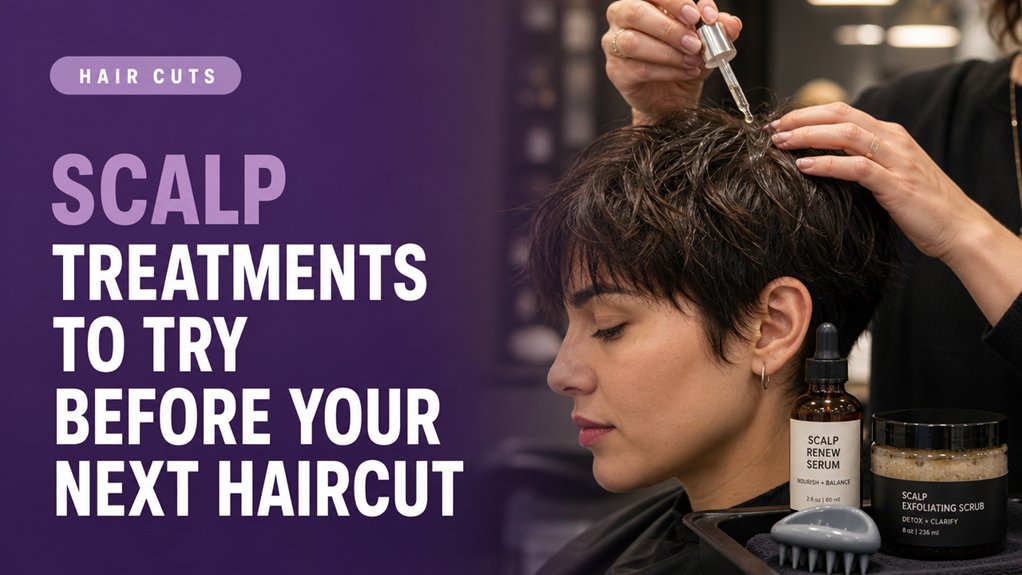
Scalp Treatments to Try Before Your Next Haircut
Scalp condition directly shapes haircut quality, affecting sectioning accuracy, line clarity, and how evenly color or treatments absorb. Exfoliation clears follicular debris and excess sebum, while salicylic acid shampoos dissolve compacted scale in oily or dandruff-prone scalps. Antifungal options like ketoconazole 2% reduce Malassezia-related buildup markedly within weeks. Scalp massage boosts circulation, and oil treatments reinforce the lipid barrier on dry scalps. A structured pre-appointment protocol covers each of these approaches in practical detail.
Key Takeaways
- Exfoliate your scalp 1–2 days before your haircut using salicylic acid or a sugar scrub to clear buildup and flaking.
- Salicylic acid shampoo used the night before reduces visible scaling without leaving the scalp overly stripped on cutting day.
- Physical exfoliation with a silicone scalp brush improves circulation and helps medicated treatments penetrate follicles more effectively.
- A clean, buildup-free scalp reveals true curl pattern and supports accurate sectioning, elevation, and clean parting lines.
- Avoid exfoliation before your appointment if you have active infections, open sores, or broken scalp skin.
Why Your Scalp Condition Affects Your Haircut Results

Most people don’t think twice about their scalp’s condition before sitting in a barber’s or stylist’s chair, yet the scalp’s health directly shapes the quality, density, and manageability of the hair being cut.
The scalp’s condition dictates what any haircut can realistically deliver, yet most never consider it.
Oxidative stress from an impaired scalp alters cuticle keratinization, producing fibers more vulnerable to mechanical damage and less responsive to tools.
Chronic inflammation from dandruff or seborrheic dermatitis disrupts the growth cycle, accelerating shedding and creating uneven density that complicates blending and fade precision.
Impaired sebum production reduces combability, compromising sectioning accuracy and elevation consistency during the cut.
Flaking and excess oil obscure clean lines and partings, undermining the finished result’s polish. Professional smoothing and hydrating treatments can restore moisture balance to the scalp and hair shaft, creating a healthier foundation that improves product penetration and overall manageability before a cut.
Collectively, these scalp-driven variables directly influence what a haircut can realistically achieve. Malassezia globosa naturally lives on every scalp and triggers a chain of inflammatory responses that, left unmanaged, compromise the very hair a stylist is working with.
Veterans and active-duty personnel face compounding scalp health challenges, as military toxic exposures have been linked to heightened inflammatory conditions including asthma and other systemic responses that can manifest in skin and scalp tissue.
Start With a Scalp Exfoliation Scrub or Brush
Scalp exfoliation removes dead skin cells, excess sebum, and product buildup from follicular openings, creating a cleaner surface that improves shampoo and treatment absorption before a haircut.
Both physical scrubs and chemical formulations containing hydroxy acids address different levels of buildup, while silicone brushes provide mechanical exfoliation alongside enhanced microcirculation. Salicylic acid, being oil-soluble, is particularly effective for oily or acne-prone scalps as it penetrates pores to remove excess sebum.
Selecting the appropriate method depends on scalp type, buildup severity, and sensitivity level. Physical exfoliants such as sugar, salt, or ground coffee mechanically lift debris through friction-based removal. A clean, healthy scalp also creates an optimal foundation for professional blowout techniques that enhance volume, shine, and overall hair appearance. Avoid exfoliation if you have active scalp infections, open cuts or sores, or a lice infestation, as these conditions can worsen with mechanical or chemical irritation.
Benefits of Scalp Exfoliation
Before reaching for a shampoo bottle, incorporating a scalp exfoliation scrub or brush into a pre-haircut routine addresses buildup at its source. Mechanical or chemical exfoliation removes dead skin cells, excess sebum, and styling residue that standard shampoos often leave behind, reducing follicle congestion linked to inflammation and shedding.
Physical exfoliation stimulates local microcirculation, improving oxygen and nutrient delivery to hair follicles while allowing emerging fibers to grow without debris obstruction. Cleared follicles also absorb serums and medicated treatments more effectively, as active ingredients contact skin directly rather than sitting atop residue films.
For oily scalp types, regular exfoliation rebalances sebum production and lowers conditions favorable to Malassezia overgrowth. It also decreases itch and mild flaking, supporting a healthier scalp environment ahead of any haircut appointment. Exfoliating before shampooing on a damp scalp ensures loosened buildup and dead skin cells are fully rinsed away during the wash that follows.
Chemical exfoliation options such as salicylic acid, glycolic acid, and lactic acid offer targeted approaches depending on scalp type, with salicylic acid penetrating pores to dissolve stubborn oil and product buildup more thoroughly than surface-level scrubbing alone.
Choosing Your Exfoliation Method
Choosing the right exfoliation method starts with identifying scalp type, since the same tool or formula that benefits an oily scalp can aggravate a dry or sensitive one.
Oily, dandruff-prone scalps respond well to salicylic acid treatments or sugar scrubs, which loosen compact scale and excess sebum.
Dry scalps benefit from lactic acid formulas or oil-enriched sugar scrubs that exfoliate without stripping moisture.
Sensitive scalps warrant fingertip-only massage with mild, fragrance-free chemical exfoliants rather than coarse physical scrubs or stiff brushes.
For long, dense, or textured hair, a silicone scalp brush distributes product more effectively than granular scrubs alone.
Anyone with broken, inflamed, or diseased scalp skin should consult a dermatologist before attempting any exfoliation method. A 2018 study found a correlation between scalp health and hair growth, reinforcing the value of proper exfoliation as part of a scalp care routine.
Clarifying shampoos and scalp exfoliants solve different problems, as clarifiers remove film from hair while exfoliants target the dead cells and sebum buildup directly on the skin surface.
Physical exfoliation tools such as scrubbing combs and scalp brushes work by massaging the scalp to remove dead skin and product residue that accumulates between washes.
How Salicylic Acid Shampoos Clear Stubborn Buildup
Salicylic acid functions as a beta-hydroxy acid that penetrates the scalp’s lipid-rich environment, softening the bonds between compacted corneocytes so adherent flakes and oily residue rinse away cleanly.
Its oil-soluble structure allows it to mix with sebum and reach follicular openings, where it disrupts keratin plugs and clears the thick scale associated with dandruff, seborrheic dermatitis, and psoriasis.
Dermatologists typically recommend using a 1–3% salicylic acid shampoo one to three times weekly, with a 3–5 minute contact time, adjusting frequency based on the scalp’s response. Because salicylic acid does not target Malassezia yeast, the underlying fungal driver of dandruff, pairing it with an antifungal ingredient produces more complete and lasting results.
Some formulations, such as Neutrogena T/Sal, are developed without added color, fragrance, or preservatives to minimize the risk of additional scalp irritation from unnecessary chemical additives. A clean scalp baseline also supports better outcomes when pursuing professional hair coloring services, as buildup-free follicles respond more evenly to applied color.
By clearing accumulated sebum and dead skin cells from the follicular surface, salicylic acid improves the scalp’s receptivity so that follow-up treatments penetrate more effectively and deliver more consistent results.
How Salicylic Acid Works
Most shampoos rely on water-soluble surfactants to cleanse the scalp, but salicylic acid works differently. As a beta-hydroxy acid, it’s lipophilic, meaning it mixes with sebum and penetrates the lipid-rich stratum corneum rather than sitting on the surface. This oil solubility allows it to reach follicular openings where sebum, dead cells, and product residue accumulate.
Once inside these layers, salicylic acid acts as a keratolytic and desmolytic agent, breaking down the intercellular bonds holding compacted corneocytes together. This loosens adherent scale, dissolves keratin plugs, and facilitates rinsing of thick flaking associated with dandruff and seborrheic dermatitis. Clinical evidence supports concentrations of approximately 1.3–3% for reducing visible scaling, erythema, and itching, while its anti-inflammatory properties further calm irritated scalp tissue. Because salicylic acid does not directly target Malassezia yeast, it is most effective when rotated with antifungal shampoos containing actives such as ketoconazole or zinc pyrithione.
Conditions such as scalp psoriasis and seborrheic dermatitis involve accelerated keratinocyte turnover, which drives the overproduction of dead cells that accumulate faster than standard cleansing can address, making salicylic acid’s structural dismantling action particularly valuable in these cases.
Best Usage Frequency Tips
Getting the frequency right with salicylic acid shampoos determines how effectively they clear stubborn buildup without compromising the scalp’s lipid barrier.
For active dandruff or oily scalps, 2–3 uses per week represents the standard therapeutic starting point. Those managing scalp psoriasis or product buildup typically benefit from 1–2 weekly applications to balance efficacy with irritation risk.
During flare-ups of seborrheic dermatitis or severe scaling, daily use under dermatologic supervision may be warranted until symptoms resolve. High-strength 6% formulas can be applied repeatedly until thick scale clears, then reduced to occasional maintenance.
On non-salicylic days, a gentle non-medicated shampoo preserves scalp hygiene without excessive dryness. Dry or color-treated hair warrants limiting applications to once every one to two weeks to protect fragile strands. Its oil-soluble properties allow salicylic acid to penetrate deep into follicles, dissolving bonds between dead skin cells and accumulated sebum.
Because salicylic acid can increase sensitivity to sunlight, wearing protective clothing and applying sunscreen on days of use helps guard against heightened sun exposure risk. Always apply the shampoo to wet hair, massage thoroughly into the scalp to build a full lather, and rinse completely before styling. After symptoms clear, shifting to once or twice weekly maintenance dosing helps sustain results without over-stripping the scalp.
The Best Antifungal Shampoos for Dandruff Before Your Cut
- Ketoconazole 2% delivers an 88% response rate in moderate-to-severe dandruff after twice-weekly use for 2–4 weeks.
- Ketoconazole 1% (OTC) suits milder cases, used every 3–4 days for up to 8 weeks.
- Selenium sulfide 2.5% markedly reduces scaling, erythema, and pruritus within 4 weeks with a strong safety profile. It is intended for external use only and should never be ingested.
- Zinc pyrithione shows statistically significant dandruff reduction after as few as 3 washes, making it ideal for regular maintenance.
- Ciclopirox olamine 1.5% provides effective prophylaxis where *Malassezia furfur* involvement is confirmed.
- Selenium sulfide 0.5% has also demonstrated clinical benefit in adolescents, with total dandruff scores dropping from 566 at baseline to 194 at week 4 following a three-to-four-times-weekly application regimen.
Each option targets fungal load directly, improving scalp condition before a cut.
Should You Use a Medicated Shampoo the Night Before a Haircut?
Using a medicated shampoo the night before a haircut offers a practical balance between therapeutic benefit and scalp readiness, as the 12–24 hour window allows active ingredients like salicylic acid or coal tar to reduce scaling without leaving the scalp overly stripped on the day of the cut.
Dermatological guidance supports this timing, noting that pre-appointment treatment clears caked-on scale, reduces visible flaking, and creates a cleaner working surface for the stylist. Using a clarifying shampoo beforehand removes debris and buildup, allowing the medicated shampoo to penetrate the scalp more effectively.
Formula selection matters, however, since stronger actives carry a higher risk of dryness and temporary texture changes, making diluted application and post-wash conditioning essential steps for maintaining hair manageability before cutting. This is especially relevant for curly, coily, or wavy hair types, where clean hair reveals shrinkage and true curl pattern, helping the barber make accurate cutting decisions.
When bringing medicated shampoo to the salon, informing the stylist of any known scalp sensitivities beforehand ensures the visit goes smoothly and reduces the risk of product-related irritation during the appointment.
Medicated Shampoo Timing Benefits
When someone using ketoconazole shampoo on a maintenance schedule plans a haircut, aligning that dose with the night before the appointment can serve both therapeutic and cosmetic goals without adding an unscheduled application.
Key timing benefits include:
- Reduced visible scaling at the salon, minimizing flakes during sectioning and clipper work
- Full contact time of 3–5 minutes completed at home allows thorough rinsing before arrival
- Hair recovery time overnight prevents residual product from interfering with chemical services
- Schedule adherence maintained when the maintenance interval naturally coincides with the appointment
- Improved cutting field for stylists due to reduced Malassezia-related buildup
This approach respects recommended intervals, avoids unscheduled doses, and reduces scalp conditions that might otherwise be prominent during the visit. Without a continued maintenance routine, relapse rates rise significantly, as studies show nearly half of patients on placebo experienced recurrence compared to roughly one in five who maintained ketoconazole use. The maintenance schedule itself follows a cadence of once every 1–2 weeks, making it straightforward to shift a planned application by a day or two to land on the evening before a haircut appointment.
Scalp Condition Before Cutting
Timing a medicated shampoo dose the night before a haircut addresses more than scheduling convenience—it also raises a prior question: whether the scalp’s current condition permits a haircut at all.
Cosmetology and barbering regulations defer hair services when open sores, weeping lesions, pustules, or broken scalp skin are present. If medicated shampoo use coincides with worsening inflammatory signs, professionals advise stopping treatment and seeking clinical evaluation before scheduling any salon visit.
Mild dandruff on an intact scalp, however, generally permits services to proceed with gentle technique. Scalp psoriasis, though non-contagious, warrants guarded clippers rather than close razor work to minimize Koebner phenomenon risk.
Confirming the scalp’s baseline condition before the appointment determines whether the overnight treatment strategy is appropriate to pursue at all.
Choosing the Right Formula
Whether to reach for a medicated shampoo the night before a haircut depends primarily on whether an active scalp condition warrants it.
Ketoconazole 1% and 2% formulas serve distinct purposes and schedules:
- Ketoconazole 1% (OTC): Use every 3–4 days for up to 8 weeks, then only as needed
- Ketoconazole 2% (prescription): Use twice weekly for 2–4 weeks, then once every 1–2 weeks
- Pityriasis versicolor: Follow a 3–5 day short course; avoid adding off-schedule washes
- No active condition: Choose a non-medicated shampoo to prevent unnecessary irritation
- Frequency violations: Exceeding labeled intervals increases scalp dryness risk
Pre-haircut timing should integrate naturally into an established treatment schedule rather than prompt an unplanned application.
How to Layer Scalp Treatments Without Causing Buildup

Layering scalp treatments effectively starts with a lightest-to-heaviest application order, which prevents occlusion and reduces product stacking at the root zone.
Water-based serums and clinical actives—such as minoxidil, niacinamide, or peptide formulas—go directly onto a clean, towel-damp scalp first. Oils follow only on mid-lengths and ends, since they create a barrier that blocks absorption of active ingredients applied afterward.
Allowing 30–60 seconds between each layer minimizes pilling and unwanted product mixing. Water-based actives benefit from a 2–5 minute absorption window before any subsequent product is applied.
Avoiding heavy creams, butters, and styling products at the root zone keeps the scalp surface clean and treatment-ready. Pre-wash scrubs used before shampooing lift existing buildup, ensuring later treatments contact the scalp more evenly.
Scalp Massage for Better Circulation and Thicker-Looking Roots
Once the scalp is free of buildup and treatments are properly absorbed, scalp massage becomes a practical next step for supporting follicular health before a haircut.
Research supports several measurable effects:
- Blood flow increases up to 38% during massage, peaking around minute three
- Hair shaft thickness improved approximately 8% after 24 weeks of daily four-minute sessions
- Dermal papilla cells respond to mechanical stretching by upregulating growth-supportive genes
- Nearly 70% of participants in two separate cohorts reported reduced shedding or improved density after consistent practice
- Results require cumulative effort, with perceived changes averaging 36.3 total hours of massage time
Circulation effects remain transient, returning to baseline within 12 minutes, but regular mechanical stimulation appears to meaningfully influence follicular diameter over time.
Scalp Oil Treatments for Dry, Tight, or Itchy Scalps
Scalp oil treatments address dryness, tightness, and itch by reinforcing the lipid barrier and reducing transepidermal water loss before cleansing strips the skin further.
Scalp oil treatments reinforce the lipid barrier, easing dryness, tightness, and itch before cleansing compounds the damage.
Jojoba oil’s sebum-mimicking profile makes it a clinically sound choice for sensitive or flaky scalps, as its lightweight structure reduces follicular obstruction risk compared with heavier occlusives.
Applying one to two teaspoons directly to a dry, sectioned scalp with gentle massage, then allowing a contact time of 20–60 minutes, delivers measurable surface comfort improvements.
Warming the oil to approximately 37–45°C enhances spreadability and penetration.
A mild shampoo removes residue without eliminating protective lipids.
Practitioners recommend one to two sessions weekly for ongoing hydration, with fragrance-free formulations strongly preferred to avoid compounding irritation in already-sensitized scalp tissue.
Tea Tree and Botanical Options for Visible Flakes
When visible flakes signal dandruff rather than simple dryness, tea tree oil offers one of the more rigorously studied botanical interventions available before a haircut. A randomized trial using 5% tea tree shampoo demonstrated a 41% improvement in lesion scores versus 11% with placebo. Its active compound, terpinen-4-ol, targets Malassezia fungi directly responsible for flaking.
Key clinical considerations include:
- Concentration: 1–2% dilution is standard for safe scalp use
- Efficacy: Scaling reductions reach 41%; itch reductions reach 23%
- Mechanism: Fungicidal and anti-inflammatory actions address root causes
- Combinations: Pairing tea tree with rosemary or peppermint enhances anti-Malassezia activity
- Safety: Oxidized oil increases sensitization risk; proper storage matters
Applying a properly diluted formula several days before a haircut optimizes scalp condition visibly.
Your Pre-Haircut Scalp Treatment Schedule, Day by Day
Timing scalp treatments strategically in the days before a haircut produces measurably better outcomes than ad hoc application.
Seven to five days prior, a clarifying shampoo strips product buildup, while gentle chemical exfoliation removes follicular debris one to two times weekly.
Four to three days out, daily serums or hydrating tonics address specific scalp conditions, and a deep conditioning masque strengthens hair structure.
Research confirms that normalized scalp condition directly improves hair quality.
Two days before, washing stops, allowing natural oils to accumulate as a protective barrier.
One day prior, light exfoliation clears residual dead skin without provoking irritation, and heavy styling products are discontinued entirely.
Following this sequenced protocol guarantees the scalp arrives at the appointment clean, hydrated, balanced, and chemically receptive.
Frequently Asked Questions
Can Scalp Treatments Affect Hair Color Results at the Salon?
Scalp treatments markedly affect hair color results. Buildup blocks even dye penetration, causing patchy color, while clarifying treatments improve uptake. Timing’s pivotal—treatments done 3–5 days before coloring optimize results without irritating the scalp during chemical processing.
Are Scalp Treatments Safe to Use During Pregnancy or Breastfeeding?
Most scalp treatments are safe during pregnancy, though experts recommend avoiding minoxidil and formaldehyde-releasing keratin treatments entirely. The second trimester’s roughly 15-week window offers the safest treatment opportunity, while well-ventilated settings reduce chemical inhalation risks substantially.
Can Children Use Medicated Scalp Treatments Before a Haircut?
Children can use certain medicated scalp treatments before a haircut, but age restrictions apply. Products like zinc pyrithione suit children over two, while ketoconazole and T/Gel shampoos require children to be twelve or older.
Do Scalp Treatments Expire, and How Should They Be Stored?
Like forgotten fruit on a shelf, scalp treatments do expire. They’re best stored in cool, dark spaces, sealed tightly after use, as heat and air accelerate breakdown, reducing efficacy and risking microbial contamination.
Can Scalp Conditions Like Psoriasis Be Worsened by Salon Products?
Salon products can worsen psoriasis. Sulfates strip moisture, drying alcohols disrupt the scalp barrier, and fragrances trigger allergic reactions. Chemical services containing paraphenylenediamine, persulfates, and formaldehyde further provoke inflammatory flares in psoriasis-prone individuals.
Conclusion
A healthy scalp isn’t just cosmetic — it directly shapes haircut outcomes. Research shows that roughly 50% of the global population experiences some form of scalp disorder, making pre-cut scalp care clinically relevant, not optional. Consistent use of exfoliants, medicated shampoos, and targeted oils prepares the scalp’s surface for precise cutting and styling. Stylists work more effectively on balanced, buildup-free scalps, and clients see measurably better results when they’ve treated the foundation first.
References
- https://pubmed.ncbi.nlm.nih.gov/7718463/
- https://pmc.ncbi.nlm.nih.gov/articles/PMC4852869/
- https://pmc.ncbi.nlm.nih.gov/articles/PMC3100109/
- https://pubmed.ncbi.nlm.nih.gov/1969208/
- https://onlinelibrary.wiley.com/doi/full/10.1111/jocd.14362
- https://pmc.ncbi.nlm.nih.gov/articles/PMC9365318/
- https://pmc.ncbi.nlm.nih.gov/articles/PMC11416180/
- https://pubmed.ncbi.nlm.nih.gov/3159759/
- https://pmc.ncbi.nlm.nih.gov/articles/PMC3129121/
- https://www.aafp.org/afp/2000/0501/p2703
- https://pmc.ncbi.nlm.nih.gov/articles/PMC3579488/
- https://pmc.ncbi.nlm.nih.gov/articles/PMC6369642/
- https://scienceinsights.org/what-does-dandruff-do-to-your-hair-and-scalp/
- https://onlinelibrary.wiley.com/doi/full/10.1111/ics.12708
- https://www.health.com/does-dandruff-cause-hair-loss-11751262
- https://ma1.mdedge.com/node?page=5188
- https://sons.co.uk/blogs/journal/the-scalp-hair-health-connection-you-shouldn-t-ignore
- https://www.headandshoulders.co.uk/en-gb/all-articles/scalp-conditions/healthy-scalp-healthier-hair/
- https://www.capilclinic.com/how-severe-dandruff-can-impact-hair-follicles-a-deep-dive/
- https://www.verywellhealth.com/does-dandruff-cause-hair-loss-8351172