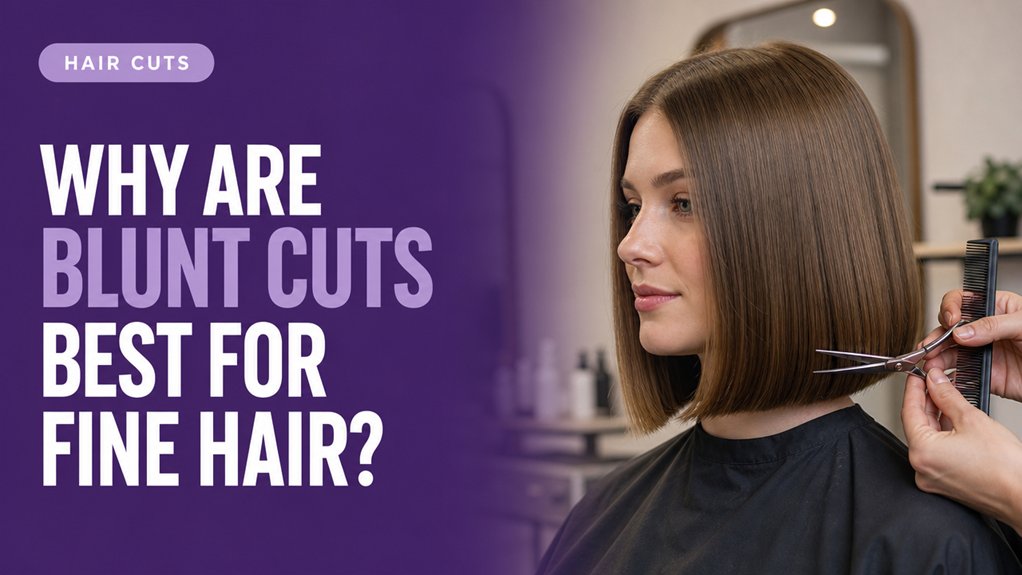
Why Are Blunt Cuts Best For Fine Hair?
Blunt cuts suit fine hair because they align every strand end at a single outline, concentrating limited fiber density into a solid, light-reflecting perimeter that makes thin strands read as thicker. Zero-degree elevation retains maximum weight at the hemline, while the uniform edge reflects light evenly, producing a stronger visual mass. Wispy, tapered alternatives scatter that weight and expose see-through gaps. Understanding the mechanics behind elevation, length selection, and maintenance reveals exactly how to keep that density advantage working.
Key Takeaways
- Blunt cuts align all strand ends at one outline, creating visual density that makes fine hair appear thicker and fuller.
- A uniform perimeter concentrates strand endpoints into a solid visual wall, eliminating see-through gaps common in fine hair.
- Zero-degree elevation retains maximum perimeter weight, producing the strongest, densest outline suited for fine hair.
- Blunt edges reflect light evenly, producing a stronger hem that reads as mass, amplifying perceived fullness by approximately 30%.
- Unlike layers or thinning, blunt cuts preserve structural integrity at the hem, preventing wispy, limp, see-through ends.
Why Fine Hair Needs a Blunt Cut Specifically
Fine hair’s low strand diameter, minimal density, and high fragility make it uniquely dependent on a strong, even perimeter to function well as a haircut.
Because individual strands carry little inherent weight, the cut must redistribute rather than subtract bulk. Blunt cutting achieves this by aligning all strand ends at a single outline, creating the visual density that fine strands can’t produce independently. Tapering, feathering, or aggressive layering disperses what little weight fine hair possesses, producing sparse, limp ends and a weakened perimeter.
A clean, hard edge also limits split-end migration by removing compromised ends in one precise line. Internal thinning is discouraged entirely for fine textures, as concentrated density at one length preserves structural integrity where fine hair needs it most—at the hem. Stylists who undergo continuous education in techniques are better equipped to identify the precise perimeter adjustments that protect fine hair from unnecessary thinning.
A blunt cut also supports the consultation process, as damage patterns inform the stylist about appropriate shape and perimeter adjustments specific to where fine hair is most vulnerable.
Scheduling trims every 6–8 weeks is essential for maintaining the clean lines that keep a blunt cut functioning effectively for fine hair. Achieving that clean line depends entirely on the tool used, as research confirms that dull blades shift the cutting mechanism from slicing to tearing, driving centre splitting from internal stress that fine hair is least equipped to withstand.
How Blunt Cuts Create the Illusion of Thicker Hair
Blunt cuts don’t just remove length—they engineer the appearance of density through several converging optical mechanisms.
Blunt cuts don’t just trim length—they strategically construct the illusion of density through precise, converging optical design.
A uniform perimeter concentrates all strand endpoints along a single line, producing a solid visual wall that eliminates the see-through gaps characteristic of tapered or feathered ends. This continuous edge reflects light evenly, generating a stronger, darker band at the hem that the eye reads as substantial mass.
Removing wispy, thinned tips exposes only the thickest portion of each strand, immediately strengthening the perimeter’s visual weight. Pairing this cut with dimensional blonding techniques like babylights or foil highlights can further amplify the illusion of thickness by adding depth and contrast throughout the hair.
The geometric precision of a straight baseline also creates an architectural stacking effect—strands gather at one endpoint, structurally mimicking density without internal layering. Some reports cite up to 40% thicker-looking results in fine or thinning hair, attributing the gain entirely to perimeter geometry.
If a styling website or resource fails to load due to server resource issues, refreshing after a short wait typically restores access without any lasting disruption to research. Platforms like SURGA11 support 5 million users across multiple devices with a clean, easy-to-understand interface suited for browsing any type of content.
Every strand is kept at exactly the same length in a one-length blunt cut, forming a solid, thick curtain that moves as a cohesive unit and prevents thinning at the ends where fine hair appears finest.
How Weight Distribution Makes or Breaks the Effect
Weight distribution determines whether a blunt cut amplifies fine hair’s density or exposes its limitations.
Keeping mass concentrated at the perimeter—rather than dispersed through heavy internal layers—maintains the solid hemline that makes fine strands appear thicker and more substantial.
Protecting that hemline from aggressive texturizing or overlayering preserves the structural edge that blunt cuts depend on to produce their signature weight illusion. A professional blowout after cutting reinforces the blunt perimeter by smoothing each strand to the same endpoint, maximizing the density illusion the cut creates.
Blunt edges reflect light uniformly across the hair surface, amplifying the perception of fullness by approximately 30% compared to layered ends that create transparency at the tips.
Tapered or worn ends scatter strand lengths unevenly, causing the final inch of fine hair to read as see-through where a blunt perimeter stops all strands at the same line to mask that loss of density.
Thinning shears and slide cutting remove density from the mid-lengths and outline, leaving short broken pieces at varying heights that undermine the uniform perimeter a blunt cut relies on to create its fullness effect.
Weight at the Perimeter
Every strand of fine hair‘s structural integrity lives or dies at the perimeter. A blunt cut concentrates the entire remaining hair mass at the outer edge, stacking ends at identical lengths and increasing perceived density by approximately 27% compared to point-cut finishes. That alignment creates a single, unified landing point where the hem reads thick even when crown density runs low.
The trade-off demands precision. Perimeter weight strengthens the outline while simultaneously pulling root volume flatter against the scalp—a critical consideration for strands measuring under roughly 50 microns in diameter. Keeping blunt perimeters positioned between the chin and collarbone limits gravitational drag while sustaining responsive movement. Excessively low placement allows weight to pull the silhouette downward, narrowing the shape and collapsing whatever lift the roots managed to produce. The blunt-line geometry softens predictably as individual strands grow at different rates, causing the perceived density advantage to decline approximately 8% per week after the fourth week. Techniques that thin the perimeter—such as razoring and thinning shears—remove the visual density that a blunt hem works to preserve, undermining the entire weight-distribution strategy.
Avoiding Heavy Internal Layers
While the perimeter delivers visual density at the hem, internal weight distribution determines whether that density holds throughout the shape. Heavy internal layering removes bulk from fine hair shafts, creating multiple shorter lengths that visually break up mass and produce a stringy, transparent result. Fine hair can’t afford that loss.
Blunt-focused cuts with only subtle interior changes maintain a continuous line of weight inside the shape, helping fine strands read as thicker without relying on backcombing or volumizing products. Where movement is necessary, soft invisible layers introduce slight swing without collapsing structural support. Thinning shears and aggressive razoring strip away the very volume fine hair needs most.
Strategic interior adjustments stay targeted and minimal, preserving density from roots to ends and extending the cut’s longevity between appointments. If your stylist’s website is temporarily inaccessible due to a server timeout error, attempting to rebook or review aftercare guidance in a few minutes is the recommended course of action. Lightweight styling products applied through the lengths and ends support this density without weighing fine strands down further.
Protecting the Hemline
The hemline makes or breaks a blunt cut on fine hair, and weight distribution along the perimeter determines which outcome a stylist delivers. Zero-degree elevation retains maximum perimeter weight, producing the densest possible outline. Higher elevation diffuses that density, risking a see-through edge on fine strands. Regular micro-trims preserve line integrity, while aggressive point cutting disperses hemline weight across micro-levels, undermining the solid outline fine hair requires.
| Elevation Angle | Weight Placement | Hemline Effect |
|---|---|---|
| 0° | Maximum at perimeter | Strongest blunt outline |
| 45° | Soft graduation | Controlled diffusion |
| 90° | Distributed into layers | Reduced perimeter density |
| 180° | Bulk pushed upward | Compromised hemline solidity |
| Inconsistent tension | Uneven distribution | Dips and corners appear |
Chin-to-collarbone length balances movement with adequate perimeter weight, extending hemline longevity before daily wear thins the ends. When internal layers are desired without sacrificing the exterior line, stylists like Fallon Fitzgerald recommend cutting on dry, flat-ironed hair to remove weight from underneath sections while keeping the outer perimeter visibly intact.
Which Blunt Cut Lengths Work Best for Fine Hair?
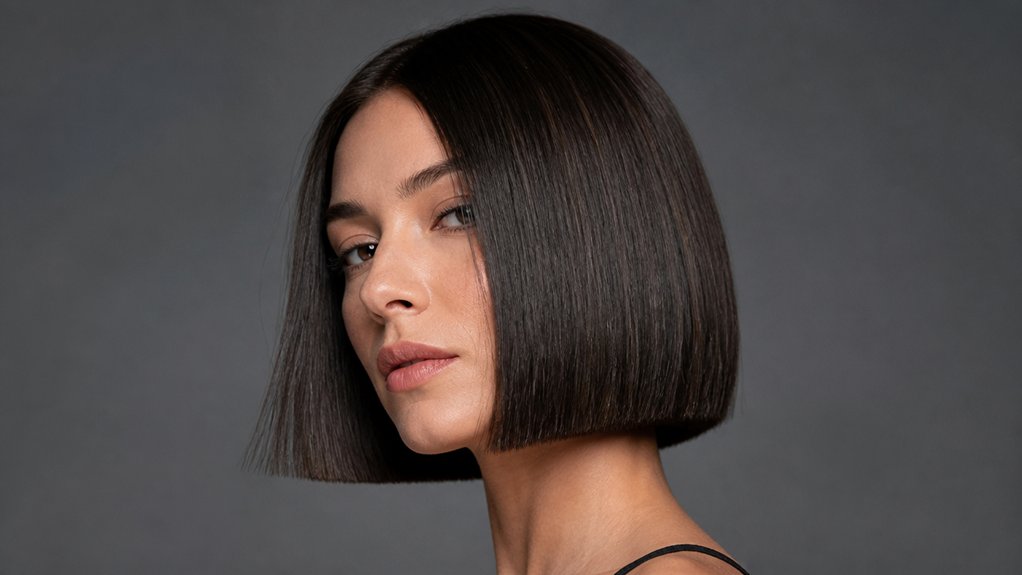
Choosing the right blunt cut length for fine hair comes down to one core principle: shorter lengths stack fiber density at the hemline, while longer lengths risk collapsing under their own weight.
Shorter blunt cuts stack density at the hemline; longer lengths risk collapsing under their own weight.
Chin-length blunt cuts deliver maximum fullness, preventing fine strands from flattening under excess weight.
Jaw- to neck-length cuts remain highly effective, maintaining a solid, readable perimeter while staying within the short-to-mid range stylists consistently recommend.
Collarbone length marks the practical upper boundary, where a strong blunt hemline still produces visible density before weight-induced thinning becomes a concern.
Shoulder-length blunt cuts remain workable when the hemline stays clean and unbroken, keeping strands visually unified. To maintain that clean line, the perimeter requires a trim every six to eight weeks.
Beyond the shoulder, fine hair increasingly struggles to maintain fullness without strategic support. At any length, blunt cuts work best when paired with lightweight volumizing products that enhance fullness without flattening the hemline.
Blunt Bob vs. Blunt Lob: Which Is Better for Fine Hair?
Both the blunt bob and the blunt lob promise a clean, weight-stacking hemline, but they don’t deliver identical results on fine hair.
| Feature | Blunt Bob | Blunt Lob |
|---|---|---|
| Perimeter density | Higher; strands stack compactly | Slightly softer; weight spreads over length |
| Root lift | Better; shorter length reduces drag | Minor drag risk on collapsible hair |
| Styling versatility | Limited; down styles dominate | Broader; waves, half-up, low buns |
The blunt bob concentrates all fine strands at a shorter point, producing a denser, less see-through hem. The blunt lob trades a small amount of that edge density for length, revealing more styling options and wave-friendly texture. Fine hair prioritizing maximum thickness illusion favors the bob; fine hair prioritizing versatility favors the lob. The lob’s length between the collarbone and shoulder tops also allows for low ponytails and half-up styles that the shorter bob simply cannot accommodate. When styling the lob, combining soft beachy waves with the blunt perimeter enhances the illusion of thickness in the mid-lengths while keeping ends looking defined and full. For fine hair in particular, stylists advise against over-thinning during cutting, as removing too much weight undermines the density that a blunt hemline is specifically designed to create.
Why Layers and Razors Work Against Fine Hair
While a blunt cut stacks fine strands into a denser, more unified hemline, the opposite approach—layers and razor work—systematically dismantles that density.
Layers strip bulk from already-sparse ends, producing wispy, see-through hemlines that read as stringy rather than full.
Because fine hair shafts carry a smaller cross-sectional diameter, repeated point-cutting and thinning accelerate splitting and breakage at the most fragile sections.
Removing weight from the crown and mid-lengths also collapses the root zone, flattening the silhouette and exposing the scalp under light and movement.
Maintenance compounds the damage: multiple lengths require constant heat styling, product layering, and frequent salon corrections as the cut loses shape rapidly.
For fine hair, layers don’t create volume—they eliminate the structural foundation that makes volume possible. Razor cuts are particularly cautioned for fine hair because the slicing technique produces feather-light ends that further reduce the appearance of density rather than supporting it.
The razor’s slicing motion cuts in the direction of hair growth but disrupts the cuticle layer, increasing the risk of splitting, frizz, and moisture loss—consequences that fine hair, already limited in structural resilience, is least equipped to absorb.
Razor cuts are best reserved for healthy, smooth hair, as damaged or over-processed hair is especially vulnerable to the added stress of the slicing technique and should be avoided entirely.
Can Face-Framing Work With a Blunt Cut on Fine Hair?

Face-framing and blunt cuts aren’t mutually exclusive—when executed correctly, they reinforce each other.
Blunt cuts and face-framing layers aren’t opposites—done right, they work together to elevate each other.
Fine hair benefits most when shorter pieces remain concentrated at the front while the back and main lengths stay one-length, preserving the solid perimeter that creates density.
Effective placement starts at the cheekbones, jawline, chin, or collarbone, with longer starting points keeping the cut closer to a one-length structure.
Very short or heavily cut front layers thin already-fine ends, so framing stays light and restricted to a few targeted sections.
The blunt hem maintains the illusion of fullness while face-framing introduces movement and softness around facial features.
This combination delivers structural definition without sacrificing weight—the fundamental requirement for fine hair to appear thicker and healthier. Styles like a blunt midi cut pair well with tiny face-framing pieces around the front hairline to soften the look without removing density.
Regular trims every eight to ten weeks preserve the integrity of both the blunt perimeter and face-framing sections, preventing split ends from making fine hair appear thinner and undermining the fullness the cut is designed to create.
How a Hard Edge Keeps Split Ends and Damage Away
The structural benefits of a blunt cut extend well beyond aesthetics—the hard perimeter actively defends fine hair against split-end propagation and ongoing mechanical damage. Split ends function as crack initiators, allowing mechanical forces to travel up the shaft during brushing and styling. A clean, blunt edge disrupts these stress pathways, concentrating fiber strength at the tip and reducing crack propagation under everyday friction.
Blunt cuts simultaneously remove the oldest, most weathered length—segments harboring the highest concentration of existing splits. Eliminating compromised distal portions prevents damage from migrating into healthier sections above. Trichology imaging confirms that blunt ends display fewer fracture lines than untreated or tapered tips, presenting fewer exposed microfibrils where new splits can initiate. No conditioning treatment replicates this mechanical advantage; only removal of damaged length reliably stops further deterioration. For fine hair specifically, scheduling these protective trims every 4–6 weeks ensures damage is intercepted before splits have the opportunity to travel further up the shaft.
How to Style Your Blunt Cut for Maximum Volume
Styling a blunt cut on fine hair for maximum volume starts at the roots, where product selection and application technique directly determine how much lift the finished style holds.
Volumizing mousse or a root-lifting spray applied to damp roots—rather than distributed through the mid-lengths—builds a strong foundation without collapsing the blunt ends.
From there, round-brush blow-drying with sections lifted away from the scalp locks in root height and reinforces the dense, structured perimeter that makes blunt cuts work on fine hair.
Root-Lifting Techniques
Once the blunt cut is in place, root-lifting techniques become the primary tool for counteracting fine hair’s tendency to lie flat against the scalp.
Stylists begin by towel-blotting hair to damp, then rough-drying roots to 60–80% dry before introducing a brush. Sections at the crown and hairline stay approximately one inch wide, held at 90 degrees or slightly over-directed to build vertical lift where it’s most visible. A concentrator nozzle focuses heat precisely at the root base, while medium heat between 140–160°F protects fine strands. Each lifted section finishes with a 10–15 second cool shot to set the shape.
Root clips or large Velcro rollers placed along the parting maintain elevation until hair cools completely, locking in durable volume.
Volumizing Product Picks
Root-lifting technique sets the structural foundation, but product selection determines whether that volume holds through the day.
For fine, blunt cuts, the right products work synergistically across every stage of styling:
- Cleanse with purpose — Volumizing shampoos using lightweight surfactants and minimal silicones, like Hair By Sam McKnight’s Cool Girl Volume Cleanse, prevent residue buildup that collapses fine strands.
- Build with mousse — A golf-ball-sized amount of John Frieda Volume Lift Air Whipped Foam or Kérastase thickening mousse applied through mid-lengths before blow-drying creates flexible, non-crunchy body along the blunt baseline.
- Finish with texture — Oribe Dry Texturizing Spray delivers invisible grit, separating the solid blunt line into dimension that reads fuller without heaviness.
Each layer compounds volume rather than compromising it.
The Best Products for Blunt Cuts on Fine Hair
Fine hair with a blunt cut demands products that build volume and structure without collapsing the style’s clean, geometric lines. Volumizing shampoos containing caffeine and proteins, like Briogeo Clean Density Shampoo, support density without flattening strands. Lightweight conditioners formulated for fine hair maintain blunt edges without depositing heavy residue.
For styling, root-lifting sprays applied to towel-dried hair maximize scalp lift when blow-dried with a round brush. Living Proof Full Thickening Mousse forms microscopic thickening points along each strand, delivering lasting volume suited to blunt shapes. Oribe Maximista Hair Thickening Spray adds fullness while remaining weightless.
Heat protection requires spray-on mists like CHI 44 Iron Guard or Olaplex No. 9, which shield strands up to 450°F without sacrificing volume or blunt-line precision.
How Often Should You Trim a Blunt Cut on Fine Hair?

Maintaining a blunt cut on fine hair demands a disciplined trim schedule—typically every four to six weeks for short lengths, six to eight weeks for medium lengths, and eight to twelve weeks for longer styles. Fine strands break easily, and blunt perimeters expose every imperfection, making consistency non-negotiable.
Skipping trims triggers a damaging chain reaction:
- Split ends travel upward, consuming healthy length and forcing heavier future cuts.
- The crisp hemline softens, collapsing the geometric silhouette into an indistinct, layered-looking edge.
- Weakened ends thin visibly, making fine hair appear sparse and limp rather than polished.
For growth-focused clients, an eight-week interval balances length retention with end integrity—but shape preservation almost always demands trimming sooner.
Daily Wash and Heat Habits That Protect Your Blunt Cut
Washing fine hair every one to two days keeps oil from spreading along narrow strands and collapsing the blunt perimeter’s geometry. Lightweight, sulfate-mild formulas applied primarily at the scalp limit cuticle dehydration at the ends, while conditioner stays confined to mid-lengths to preserve root lift. Clarifying shampoos should remain periodic, as overuse strips lipids and roughens cuticles, fraying blunt edges.
For heat styling, flat irons should operate between 250–300°F (120–150°C), since cuticle cracking accelerates near 160°C under prolonged contact. Hair must reach complete dryness before any hot tool touches it, because residual moisture combined with high heat sharply degrades the cuticle. Applying a heat protectant to towel-dried hair before blow-drying forms a protective film that preserves the blunt edge’s clean, sharp line.
Frequently Asked Questions
Can Blunt Cuts Work for Fine Hair That Is Also Curly?
Blunt cuts work well for fine curly hair. They create a solid perimeter that adds visual weight, making ends appear thicker and fuller. Stylists recommend pairing them with interior layering to prevent a triangular, limp silhouette.
Does Hair Color or Highlights Affect How a Blunt Cut Looks?
Hair color and highlights markedly affect a blunt cut’s appearance. Solid tones sharpen the perimeter line, while balayage and highlights add dimension, softening edges and creating fullness—both techniques directly influencing how structured or relaxed the cut looks.
Are Blunt Cuts Suitable for Fine Hair With a Sensitive Scalp?
Blunt cuts can suit fine hair with a sensitive scalp when properly customized. They’ll minimize product reliance, reduce mechanical tension, and concentrate density at the perimeter, delivering visual fullness while supporting scalp comfort through low-maintenance, gentle styling routines.
Can Blunt Cuts Help Fine Hair Look Better in Humid Weather?
Blunt cuts brilliantly battle humidity’s damaging effects on fine hair. Their solid perimeter maintains visual density, resisting moisture-driven limpness. Concentrated weight at blunt ends preserves silhouette integrity, preventing humidity-induced collapse that typically flattens fine, delicate strands.
Is a Blunt Cut Still Flattering on Fine Hair as It Grays?
Yes, blunt cuts remain flattering on fine hair as it grays. They’re keeping weight concentrated at the perimeter, making strands appear thicker and reducing the translucent, sparse look that commonly affects light-toned, fine gray hair.
Conclusion
A blunt cut transforms fine hair like a freshly sharpened blade—clean, precise, and deliberate in its effect. It maximizes weight distribution along a single, unified perimeter, creating density where natural volume falls short. Stylists consistently recommend this technique because it’s the most structurally sound approach for fine hair. When paired with proper products and regular trims, a blunt cut doesn’t just improve fine hair’s appearance—it fundamentally corrects its architectural weaknesses.
References
- https://www.elle.com/beauty/hair/a71434247/best-blunt-bobs-for-fine-hair/
- https://blog.goldsupplier.com/blunt-haircut-fine-hair/
- https://www.haircutopia.com/blunt-cut-haircuts-the-complete-guide-to-clean-sharp-modern-styles/
- https://blog.goldsupplier.com/blunt-bob-fine-hair/
- https://cutandstyle.org/blunt-cut-bob-for-fine-hair/
- https://blog.goldsupplier.com/fine-hair-blunt-cut/
- https://www.elle.com/uk/beauty/hair/a71419584/blunt-bobs-fine-hair-summer/
- https://www.trendyhairpicks.com/blunt-bob-haircut/
- https://blog.goldsupplier.com/blunt-bob-hairstyles-for-fine-hair/
- https://hairiseverything.app/blog/women-hairstyles/style/blunt-bob
- https://blog.goldsupplier.com/blunt-cut-bob-fine-hair/
- https://necolebitchie.com/are-blunt-cuts-better-for-fine-hair/
- https://addictedtohairbylexi.com/haircut-for-damaged-hair/
- https://www.reddit.com/r/finehair/comments/1lkd046/blunt_cut_causing_friction/
- https://www.passion-osaka.com.au/blogs/news/dull-scissors-split-ends-hair-damage
- https://www.healthline.com/health/hair-breakage
- https://theglossylocks.com/best-haircuts-for-damaged-hair/
- https://blisstulle.com/should-i-cut-my-hair-if-its-breaking-off/
- https://www.hairgracefully.com/hair-breakage-fine-hair
- https://salonworthyhair.com/blunt-cut-frizzy-hair