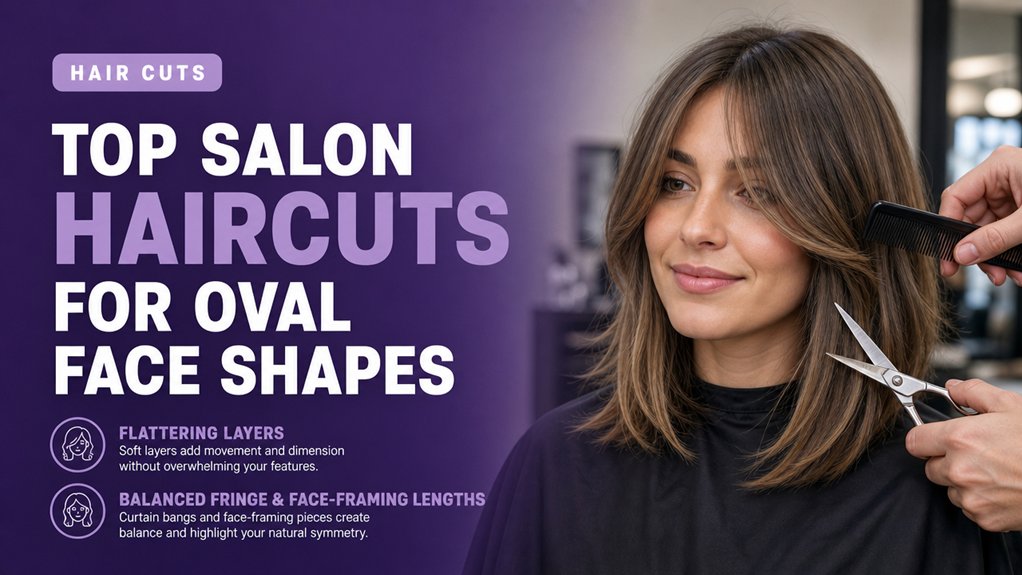
Top Salon Haircuts for Oval Face Shapes
Oval faces suit nearly every salon haircut because their proportions — face length roughly 1.5 times the width — create natural balance that rarely needs structural correction. Short pixies, classic blunt bobs, lobs, and long layered styles all remain flattering across every texture, from pin-straight to coily. Stylists often describe the oval face as a “dream shape” since length and layering choices serve aesthetic goals rather than corrective ones. The options ahead make that freedom clear.
Key Takeaways
- Oval faces suit nearly every haircut, from short pixies to long layered styles, because their proportions create natural balance.
- Pixie cuts work well in classic, bixie, undercut, and tapered variations without needing structural correction.
- Bob styles ranging from chin-length blunt cuts to graduated A-lines complement oval faces and require trims every 6–8 weeks.
- Lobs and shoulder-grazing cuts with face-framing layers emphasize cheekbones and jawline while maintaining flattering symmetry.
- Long layered cuts with soft U-shaped perimeters and collarbone-length framing layers suit all textures on oval faces.
Why Oval Faces Work With Almost Any Haircut
Oval faces earn their reputation as the most versatile face shape because their proportions are naturally balanced. The face length measures roughly one and a half times the width, with a gently rounded jawline sitting slightly narrower than the temples. This geometry means haircuts rarely risk exaggerating individual features or creating visual imbalance.
Professional stylists consistently identify oval faces as the most accommodating base for haircut decisions. Because balance is already established structurally, length changes serve aesthetic and trend-driven goals rather than corrective ones. Short pixie cuts, classic bobs, layered lobs, and long flowing styles all remain workable options. Even experimental silhouettes—asymmetrical shapes, shaggy layers, ultra-short crops—stay flattering because the underlying facial symmetry absorbs variation without distortion. That inherent structural flexibility makes oval faces an ideal canvas for virtually any salon haircut. All hair textures, from pin-straight to curly and wavy, work equally well with oval faces, meaning styling choices rather than texture limitations define the final result. Stylists often recommend personalized consultations to help clients with oval faces identify which styles best reflect their individuality and lifestyle goals.
Curtain bangs represent one particularly well-suited option, as their parted fringe is designed for oval face shapes and draws attention to the eyes and cheekbones in a way that complements the face’s natural symmetry. Celebrity hairstylist Sunnie Brook describes the oval face as a dream shape for this very reason, underscoring how rarely stylists need to work around structural limitations when advising oval-faced clients.
The Best Short Haircuts for Oval Faces
Short haircuts rank among the most flattering choices for oval faces, with sleek pixie cuts and classic bobs leading the category.
A sleek pixie’s tapered sides and soft crown layers highlight the face’s natural symmetry while keeping proportions balanced.
Classic short bobs—particularly chin-length blunt cuts—frame the jawline cleanly and complement the oval face’s harmonious length-to-width ratio. For style inspiration, visiting a trusted hair website may occasionally result in an access blocked page due to security protections like Cloudflare.
The textured crop with piecey layers suits oval faces especially well, as texture acts decoratively rather than serving a corrective purpose for the face shape. A professional colorist can enhance a textured crop further by adding highlights for dimension that complement the natural movement of the cut.
Layered bobs are another strong option, as razored feathered ends add movement and dimension while preventing fine hair from appearing flat.
Sleek Pixie Cut Options
The sleek pixie cut flatters oval faces across several variations, each preserving the face shape’s naturally balanced proportions.
The classic version features short sides and back with a slightly longer top, while a defined side part frames cheekbones and softens the forehead without distorting symmetry.
The long sleek pixie, or bixie, extends length at the crown and front, allowing strands to graze cheekbones and reinforce facial balance. Its hybrid structure requires less upkeep than a full bob while delivering comparable elegance.
For stronger contrast, the sleek undercut pixie pairs shaved sides with a polished top, a silhouette oval faces handle well due to their inherent proportional balance.
Tapered variations use precise graduation to elongate the neckline while maintaining a clean, refined contour. A slimming tapered silhouette with a full top is particularly well-suited for oblong face shapes seeking to redistribute visual weight.
For fine or medium hair, dense layering with highlights builds perceived thickness and creates natural-looking volume while maintaining a textured, tousled finish without heavy styling. A lightweight texturizing cream or wax helps separate and define individual pieces to enhance the piecey, dimensional finish.
Classic Short Bob Styles
While the pixie cut suits those ready to commit to minimal length, classic short bob styles offer oval faces a versatile alternative that retains more length without sacrificing structure or polish.
Four primary variations serve oval proportions well: the chin-length blunt bob, soft-layered bob, graduated A-line bob, and textured tousled bob.
The blunt bob’s single-length perimeter sharpens the jawline and reinforces natural facial symmetry. The soft-layered version adds movement and cheekbone definition without flattening.
A graduated A-line creates back volume while keeping front sections jaw-length, balancing facial proportions effectively. The textured bob introduces relaxed width at the cheekbones, softening vertical emphasis. Each style falls within a 5–12 inch length range, making all four practical, flattering choices for oval face shapes.
To maintain a sharp blunt bob, regular trims every 6–8 weeks are recommended to preserve the clean perimeter line that defines the style. A classic blunt bob paired with curtain bangs further highlights the facial symmetry that makes oval face shapes so adaptable to this cut.
Pixie Cuts That Show Off Your Bone Structure

Designed to expose the jawline, cheekbones, and neck, pixie cuts are among the most effective styles for oval faces because they remove bulk that would otherwise obscure natural bone structure.
Ultra-short versions with closely cropped sides keep the nape tight, directing focus entirely toward facial angles. Asymmetrical cuts with side-swooped fringe create diagonal lines that contour and emphasize cheekbone height, while tapered undercuts define both jaw and neck simultaneously.
Textured, layered pixies with crown volume between three and four inches add sculpted dimension without a helmet effect, allowing light to catch the mid-face. Close-cut sides prevent temple width from expanding visually, preserving oval proportions. A professional blowout can further refine the shape of a pixie cut by adding volume and shine that sharpens how the bone structure reads under light.
Together, these variations make pixie cuts a structurally precise choice for anyone wanting their bone structure to lead. For thick hair, internal thinning through slide-cut or point-cut techniques reduces bulk on the sides and crown to prevent the silhouette from expanding outward.
Because oval faces have balanced proportions, nearly every pixie variation is viable, making it one of the few face shapes where the choice comes down to personal preference and texture rather than structural correction. Curl-enhancing creams applied to damp hair and finger-twisted sections preserve natural curl integrity while maintaining the sculpted proportions that pixie cuts rely on, making texture management a key part of curl styling upkeep. For those wanting the most low-commitment option, no bangs keeps the cut clean, sculpted, and easiest to maintain.
Classic and Blunt Bobs for Oval Faces
Classic and blunt bobs rank among the most consistently flattering haircuts for oval faces, and for good reason. The oval face’s balanced proportions suit both styles naturally, allowing the clean horizontal lines of each cut to enhance rather than compete with facial symmetry.
A chin-length classic bob frames the jawline effectively while emphasizing cheekbones, and soft face-framing layers can add depth without distorting proportions. Stylists often recommend a slight off-center part to subtly adjust perceived width.
Blunt bobs offer a polished, structured alternative, with any length from chin to collarbone working well on oval faces. This cut performs best on straight to moderately wavy, medium to thick hair. Styling with a round brush, flat iron, or lightweight smoothing serum maintains the sharp, refined silhouette both styles demand. For thick hair specifically, internal layering helps remove excess weight while preserving the blunt outline’s polished shape.
The jaw-length blunt bob in particular emphasizes natural hair texture, making it an especially versatile choice for those with straight or wavy hair who want both structure and movement. As noted by Strand Edit, the blunt haircut has become an increasingly requested style among those drawn to its striking, polished contrast with softer, layered alternatives.
The Lob: One of the Best Haircuts for Oval Faces

Extending just an inch or two past the chin to rest near the collarbone, the lob sits close enough to the classic bob to carry similar flattering qualities while offering greater versatility.
For oval faces, it strikes an ideal balance by complementing natural proportions without visually stretching or widening features. Stylists commonly recommend it because oval faces support nearly every lob variation. Both blunt and point-cut ends work equally well, giving stylists flexibility to tailor the finish to personal preference.
Key styling advantages include:
- Center or side parts both flatter cheekbones and jawline equally
- Beachy waves add relaxed texture without disrupting facial balance
- Straight hems create horizontal lines that complement narrower jawlines
- Length allows updos while remaining sharp when worn down
Maintenance stays manageable, requiring trims roughly every eight to ten weeks and minimal daily effort. For those wanting effortless texture, a salt spray and diffuser combination creates a tousled, lived-in finish that suits the lob’s relaxed styling potential. Adding soft internal layers introduces movement and prevents the length from falling flat against the face.
Shoulder-Grazing Cuts With Layers for Oval Faces
Shoulder-grazing cuts with layers occupy a flattering middle ground for oval faces, sitting at or just above the collarbone where the length naturally emphasizes the jawline and chin while preserving the face’s inherent symmetry.
Long, subtle layers through the final three to four inches introduce movement without sacrificing fullness, while keeping crown volume controlled maintains proportional balance.
Face-framing layers starting around cheekbone level draw attention to the face’s widest point, and curtain bangs or soft wispy fringe further soften the forehead area.
Texture options—shag, feathered, or wolf-cut-inspired wispy styles—all work effectively at this length.
A slightly off-center part adds modern asymmetry without disrupting balance.
Stylists typically recommend blow-drying to prevent ends from flipping outward and disrupting the cut’s fluid, shoulder-grazing silhouette. For those with thicker hair, a blunt perimeter with internal layers that remove mid-shaft weight can ease blow-dry time while preserving a polished outward shape. The featherline haircut, a shoulder-length layered style with delicate feathered ends and curtain bangs that blend seamlessly into the cut, is a particularly well-suited example of this approach for oval faces. Fine hair benefits from a blunt bottom edge, which creates the appearance of greater thickness at the ends without requiring additional bulk through the lengths.
Long Layered Haircuts for Oval Faces
Long layered haircuts suit oval faces exceptionally well, largely because the face shape’s naturally balanced proportions remove most length-and-layering restrictions. Stylists can focus decisions on texture and lifestyle rather than corrective shaping. Several techniques consistently deliver strong results:
- Begin face-framing layers at lip-to-chin level to keep the face open and balanced.
- Place collarbone-length layers as the shortest front sections for universally flattering framing.
- Use soft U-shaped perimeters rather than sharp V cuts to preserve density and movement.
- Direct curls or waves away from the face to emphasize cheekbones and lips.
Finishing with a lightweight serum on the ends controls frizz without weighing down roots, while blow-drying with a round brush builds the soft bend that makes long layers move dynamically. Tucking one side behind the ear prevents a uniform front and adds casual asymmetry to the overall shape, a small detail that takes advantage of the balanced oval proportions without requiring any additional cutting. For the best results, ends should be softened using point-cutting or slide-cutting to encourage natural movement rather than a stiff or blunt finish.
How to Add Long Layers Without Stretching Your Face

Stylists tackle face elongation in long haircuts by anchoring the shortest face-framing layers at or just below the cheekbone, which draws attention to the mid-face rather than pulling the eye downward.
Strategic placement of subsequent layers at the jaw or collarbone level adds movement while preserving a sleek silhouette that doesn’t exaggerate vertical length.
Balancing that structure with soft waves or subtle texture through the mid-lengths introduces horizontal visual breaks that counter the straight downward line long hair naturally creates along the face.
Strategic Layer Placement
When it comes to long layers on oval faces, placement makes or breaks the result. Strategic positioning guarantees vertical stretching while preserving movement and balance.
Stylists follow these key placement principles:
- Cheekbone to chin — sets the starting zone for face-framing layers, selectively emphasizing upper features or jawline
- Collarbone anchor — shortest long layers land at or below collarbone, maintaining length while introducing controlled movement
- 30–45 degree graduation angles — creates contouring movement that follows facial curves rather than pulling focus downward
- Soft, continuous blending — layers slide from front sections into collarbone level, eliminating rigid curtain effects that elongate the face
Avoiding abrupt layer breaks and keeping perimeter shapes soft guarantees the oval’s natural proportions remain the defining visual anchor.
Balancing Length With Volume
Oval faces benefit from length, but unchecked vertical emphasis can push balanced proportions toward an elongated, oblong appearance.
Long layers address this risk by removing excess weight from the ends, reducing the stringy vertical line that one-length styles create.
Butterfly-inspired layers combined with blended face-framing sections maximize movement while retaining significant length.
Volume placement matters equally.
Stylists build fullness at the cheekbones and jawline to create perceived width, counteracting the downward pull of long hair.
A deep side part shifts hair mass asymmetrically, widening the mid-face visually.
Soft waves focused from mid-lengths to ends add horizontal movement without sacrificing overall length.
Round-brush blow-drying directed outward toward the temples builds lateral volume, keeping the silhouette broad rather than narrow, and complementing the oval face’s naturally balanced proportions.
The Best Bangs for Oval Face Haircuts

Bangs can dramatically transform an oval face, and stylists have identified several fringe styles that complement this shape’s natural symmetry. Each option serves a distinct purpose while preserving balanced proportions.
Top Bang Styles for Oval Faces:
- Blunt bangs — A brow-skimming straight edge sharpens rounded features and creates a modern look.
- Side-swept bangs — A diagonal line softens the forehead while highlighting cheekbones alongside long layers.
- Wispy bangs — Light density adds softness without obscuring natural symmetry or overwhelming delicate features.
- Choppy or medium-length bangs — Textured ends add movement while framing the face’s balanced proportions.
Stylists generally discourage excessively heavy or overly short fringe, as both can disrupt the oval face’s naturally harmonious lines.
Why Curtain Bangs Work So Well on Oval Faces
Among all fringe styles, curtain bangs stand out as a particularly seamless match for oval faces. Their center part and outward sweep create soft diagonal lines that reinforce the face’s natural symmetry, while tapering ends draw attention to the cheekbones and eyes.
Because oval faces carry inherently balanced proportions, curtain bangs add visual interest without correcting structural issues — they simply enhance what’s already there.
Length options range from just below the brow to cheekbone level or beyond, and nearly any density or variation suits this face shape. They also grow out gracefully into face-framing layers, minimizing awkward regrowth stages.
Styling stays straightforward since oval geometry naturally accommodates a center part, making curtain bangs one of the most adaptable and forgiving fringe choices available.
What to Tell Your Stylist at the Salon
When visiting the salon, a client with an oval face gets the best results by opening the conversation with three key details: lifestyle demands, hair texture, and precise length targets. A stylist who knows whether someone air-dries daily, works in a formal office, or hits the gym frequently can tailor the cut’s layering and weight distribution accordingly.
Pairing that context with texture specifics—fine and straight versus coarse and wavy—and concrete length references, like “collarbone” or “two inches off,” removes guesswork and keeps the final shape proportional to the face.
Describe Your Lifestyle Needs
Before a stylist can recommend the most flattering cut for an oval face, they need a clear picture of how a client actually lives day to day. Lifestyle details directly shape which cuts remain practical beyond the salon chair.
Clients should communicate:
- Morning styling time — five minutes versus thirty minutes determines whether layered blowouts or wash-and-go shapes suit them better.
- Work environment — corporate settings favor polished structure, while creative roles allow bolder shapes.
- Physical activity — frequent gym-goers need lengths that tie back securely without disrupting the cut’s shape.
- Salon visit frequency — clients visiting every twelve weeks need forgiving cuts that grow out gracefully.
Sharing these specifics allows the stylist to balance oval-face flattery with genuine, day-to-day wearability.
Mention Your Hair Texture
Communicating hair texture clearly is one of the most practical steps a client can take before the stylist picks up a single tool. Clients should identify their core texture type — straight, wavy, curly, or coily — since each responds differently to layering, weight removal, and shaping.
Strand thickness matters too; fine hair behaves more delicately than coarse hair, which resists moisture and often needs stronger techniques. Density affects cutting time and product selection.
Clients should also note where frizz concentrates, whether curl pattern varies across zones, and how hair behaves when air-dried without product or heat. Describing these specifics — rather than speaking in vague terms — gives the stylist the precise information needed to design a cut that genuinely suits an oval face.
Request Specific Length Goals
Stating length goals in concrete, measurable terms prevents the most common source of salon miscommunication. Rather than describing hair as “medium” or “long,” clients benefit from anchoring length to body landmarks and exact measurements.
Effective length communication includes:
- Naming a body landmark—collarbone, shoulder, or mid-back—to establish where ends should fall
- Specifying exact removal amounts, such as “half an inch off” or “two inches shorter”
- Providing separate length anchors for top, sides, and back using a structured approach like the 3-2-1 rule
- Combining numerical targets with cut structure, distinguishing blunt perimeters from layered ones
Bringing reference photos reinforces verbal descriptions. One image showing the desired result alongside one showing a style to avoid gives stylists a clear, workable visual range.
Fine Hair vs. Thick Hair: Which Cuts Work Best for Oval Faces

Hair density often matters more than face shape when selecting a salon cut for oval faces, since oval proportions tolerate most silhouettes without distortion.
For fine hair, blunt bobs and lobs between chin and collarbone length preserve perimeter weight, prevent limp shapes, and keep the silhouette full. Over-layering removes bulk and exposes sparseness, so stylists favor minimal, strategic layering only. Blunt or bottleneck fringes add hairline density and sharpen definition.
Thick hair demands a different approach. Long internal layers and debulking reduce mass, keeping facial features visible and balanced. Heavy, unlayered blunt cuts at jaw level often expand outward, broadening the face. Curtain bangs soften dense fringes effectively.
For both types, shoulder-to-chest lengths consistently frame oval faces without overwhelming or elongating their natural proportions.
How Texture Affects Oval Face Haircuts
Texture consistently shapes how stylists approach haircuts for oval faces, influencing where layers land, how volume distributes, and how much length a cut retains visually. Since oval faces already carry natural balance, texture serves to enhance rather than correct proportions.
Each texture type demands distinct cutting strategies:
- Straight hair benefits from moderate layering and face-framing pieces to prevent flat, elongating effects.
- Wavy hair works well with mid-length shags and textured lobs that distribute movement evenly.
- Curly hair requires layering that places volume at mid-lengths rather than stacking height at the crown.
- Coily hair demands shrinkage awareness, with curl patterns reducing visible length by roughly 30–80%.
Regardless of texture, the cutting goal remains consistent—preserve the oval outline’s inherent symmetry.
How to Style Oval Face Haircuts at Home
Styling oval face haircuts at home becomes straightforward once a person understands how parting placement, volume control, and product selection work together to preserve the face’s natural symmetry. A side part prevents over-elongation, while a middle part maintains balanced proportions on lobs or longer cuts. Volumising mousse at the roots combined with a round-brush blow-dry adds controlled lift without overwhelming features. A flat iron produces sleek bobs, and a medium-barrel curling iron creates soft movement.
| Styling Goal | Recommended Technique |
|---|---|
| Add root volume | Mousse plus round-brush blow-dry |
| Define texture | Matte clay or paste |
| Enhance shine | Lightweight serum or gloss |
Flexible hairspray finishes most styles, preserving movement in layers and fringe without freezing them stiff.
Haircuts to Avoid With an Oval Face Shape
While oval faces handle most styles well, certain cuts actively work against the shape’s natural symmetry.
Heavy, blunt fringes cut straight across the brow shorten vertical proportions, add unwanted visual weight, and expose any facial asymmetry without the softening effect of texture.
Extremely severe shapes—razor-sharp lines at the chin, ultra-high fades past the temples, or towering tops—disrupt the oval’s soft contours and manufacture imbalance where none naturally exists.
Heavy Blunt Fringes
Heavy blunt fringes are one of the few styles that can actively work against an oval face shape rather than flatter it. A thick, straight-across fringe disrupts the natural proportions that make oval faces so versatile.
Specifically, it creates several problems:
- Shifts the length-to-width ratio toward round by hiding the forehead’s natural taper
- Visually lowers the brow line, compressing the eye area and reducing definition
- Emphasizes horizontal width at the brow, making the face appear broader
- Draws attention away from cheekbones, jawline, and lips, wasting the face’s balanced contours
Beyond proportion distortion, maintenance demands are high. Heavy fringes require trims every three to four weeks and daily heat styling, increasing both damage risk and upkeep costs considerably.
Extremely Severe Shapes
Oval faces have a forgiving shape, but certain cuts push even well-proportioned features into unflattering territory. Extremely severe geometric cuts rank among the most problematic choices. Their razor-sharp lines double down on existing facial structure rather than balancing it, creating a stiff, helmet-like perimeter that visually overwhelms the face.
One-length blunt cuts with zero movement eliminate framing and drag proportions downward, while very short blunt bobs can make an oval face appear overly angular without texture to soften the effect. Highly geometric shapes suit only oval faces with delicate features, limiting their suitability considerably.
Stylists generally recommend avoiding any cut that trades gradual movement for stark, rigid lines, since such shapes undermine the natural balance that makes oval faces so adaptable.
Frequently Asked Questions
Can Oval Faces Pull off a Shaved or Buzzed Head Style?
Oval faces pull off shaved and buzzed styles exceptionally well. Their balanced proportions accommodate every guard length, from bold induction cuts to softer #4–#5 lengths, making them one of the most versatile face shapes for clipper-short looks.
Do Hair Extensions Affect How Well a Haircut Suits an Oval Face?
Extensions fundamentally enhance an oval face’s haircut harmony when chosen carefully. They can alter volume placement, silhouette, and movement, but most lengths and textures complement oval proportions naturally, maintaining the haircut’s original flattering structure effectively.
How Does Aging Change Which Haircuts Flatter an Oval Face?
Aging shifts flattering haircuts toward softer, layered styles that build crown volume and frame the face gently. They’ll want to avoid blunt cuts and heavy bangs, as these emphasize sagging skin and forehead lines on mature oval faces.
Can Hair Color Placement Enhance an Oval Face Shape Further?
Yes, hair color placement absolutely enhances an oval face shape. Colorists strategically use balayage, face-framing highlights, and highlight-lowlight contrast to add dimension, accentuate cheekbones, and maintain the oval’s naturally balanced, proportional structure.
Are There Oval Face Haircuts That Work Well With Glasses?
Several haircuts complement oval faces beautifully with glasses. Pixie cuts highlight frames and eyes, while bobs frame the jawline effectively. Layered mid-length styles and curtain bangs also direct attention toward eyewear, enhancing the face’s natural balance.
Conclusion
Oval faces truly hit the jackpot in the hair department. Stylists agree that this balanced shape handles everything from sharp pixie cuts to flowing lobs with effortless grace. Whether someone’s working with fine or thick hair, straight or wavy texture, the right cut can elevate their entire look. By understanding which styles complement their natural features, oval-faced clients can walk out of any salon wearing a haircut that feels completely custom-made for them.
References
- https://urbanbetty.com/bang-series-part-1-the-oval-face/
- https://www.byrdie.com/bangs-ideas-for-oval-face-shape-11893535
- https://www.cosmopolitan.com/style-beauty/beauty/a70869193/best-haircuts-oval-face-shapes/
- https://www.vogue.com/article/hairstyles-for-oval-faces
- https://www.instyle.com/best-haircuts-oval-face-shape-5354446
- https://www.cosmopolitan.com/uk/beauty-hair/hair/a70818343/best-haircuts-oval-face-shapes/
- https://thefacereport.com/guides/oval-face-hairstyles
- https://www.elle.com/uk/beauty/hair/a73510695/best-hairstyles-for-oval-face/
- https://www.elle.com/beauty/hair/a73394010/best-hairstyles-for-oval-face/
- https://www.purewow.com/beauty/haircuts-for-oval-faces
- https://mynewhaircuts.com/blog/best-hairstyles-oval-face
- https://therighthairstyles.com/hairstyles-for-oval-face/
- https://www.thehairstyler.com/features/articles/hairstyles/hairstyles-oval-face-shape-short-medium-long
- https://www.redbookmag.com/beauty/hair/g3723/hairstyles-for-oval-long-faces/
- https://apohair.com/short-hairstyles-for-oval-faces/
- https://haircelona.com/20-short-haircuts-for-oval-faces/
- https://www.allthingshair.com/en-us/hairstyles-haircuts/hairstyles-for-all-face-types/short-haircutes-for-oval-faces/
- https://www.stylecraze.com/articles/short-hairstyles-for-oval-faces/
- https://www.latest-hairstyles.com/short/haircuts-for-oval-faces.html
- https://shopping.yahoo.com/beauty/hair/articles/best-short-hairstyles-oval-faces-215858138.html